AV as a Service (AVaaS): Is It Better to Buy or Rent AV Equipment?
Reading time: 6 minutes

Quick answer
AVaaS (Audio-Visual as a Service) turns hardware purchasing into a predictable service. Instead of owning technology that quickly becomes outdated, you pay a monthly fee for its continuous functionality, service support and regular renewal. For companies, this means moving from capital expenditure (CapEx) to operational expenditure (OpEx), helping protect cash flow.
When does owning AV equipment stop making sense?
Most companies approach meeting room equipment in the same way as buying furniture. They purchase it and expect it to serve them for 10 years. With technology, however, it does not work quite that way.
Main risks of hardware ownership:
Software versus hardware lifespan: Meeting room technology does not age evenly. While high-quality displays, speakers or cabling can easily serve you for 7 to 10 years, the brain of the system, such as computing codecs and control units, becomes outdated much faster.
Due to the constantly increasing performance requirements of platforms such as Microsoft Teams or Zoom, for example for new AI features or security updates, their practical software lifespan is usually 3 to 5 years. The system may not physically break down, but its computing part gradually starts to fall behind.
Tied-up capital: By purchasing AV equipment, you tie up capital in assets that start losing value the moment they are unpacked. That money could otherwise be used to generate value in your core business.
Hidden downtime costs: When sound fails in a purchased meeting room, your IT department has to deal with it, even though they have other work to do, or you wait up to 30 days for a warranty claim. During that time, the room may be unusable.
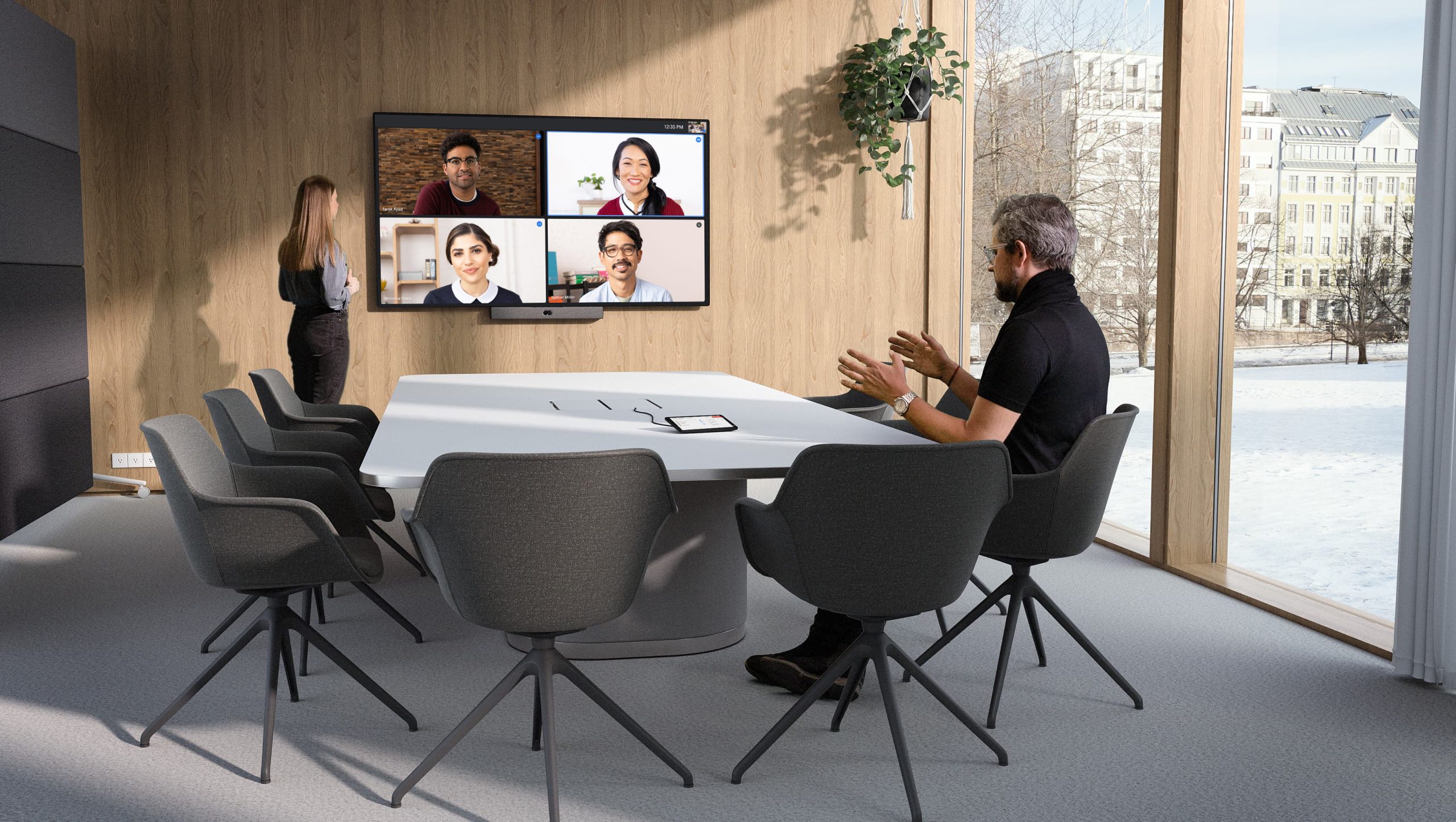
Comparison: Traditional purchase vs. AVaaS
| Parameter | Traditional purchase (CapEx) | AV as a Service (OpEx) |
|---|---|---|
Initial investment | High (thousands of euros at once) | Zero or minimal |
Impact on cash flow | One-time capital outflow | Predictable monthly payment |
Service responsibility | Internal IT department | Supplier (SLA guarantee) |
Software obsolescence | Company asset (depreciation issue) | Regular upgrade to new models |
Repair speed | Standard warranty claim (up to 30 days) | Hardware replacement (often within 24–72 hours) |
When should you consider switching to the AVaaS model?
If you recognize your company in the following situations, AVaaS may be a more effective solution for you than purchasing equipment:
- You are renovating your offices: You need to equip 5 or more rooms at once and do not want to disrupt your annual budget with a major investment.
- Your IT department is overloaded: Your technicians spend too much time fixing cables and adjusting microphones in meeting rooms.
- You need technological certainty: You cannot afford an important client meeting to fail because of a technical issue.
How does AVaaS protect your budget and your IT department’s time?
Moving to a service model is not just a change in accounting. It is a strategic decision that removes three of the biggest hidden productivity killers in modern offices.
1. No more unplanned investments
With traditional purchasing, technology ages unevenly. A camera may work for 6 years, but the control processor may stop supporting a new Microsoft Teams update after only three.
The problem with purchasing: You suddenly need to approve a budget for replacing an incompatible device that may not even be fully depreciated yet.
The AVaaS solution: The agreement includes a so-called refresh cycle. After an agreed period, the supplier automatically replaces outdated components with the latest models. Your monthly payment remains the same, but your technology stays up to date.
2. Service contract (SLA) vs. a 30-day warranty claim
What happens if a display fails in an important meeting room on Monday morning?
Ownership scenario: Your IT department has to dismantle the device, send it for service and wait for the standard warranty process, which can take up to 30 days. The meeting room may be out of operation for a month.
AVaaS scenario: The service is covered by an SLA (Service Level Agreement). The supplier monitors the system remotely and, in the event of a failure, often arrives with a replacement unit within 24 hours. You are not paying for a piece of hardware, but for the ability of the room to hold a meeting.
3. Moving responsibility from IT to a partner
IT managers are trained in network security and data management, not in repairing HDMI cables or calibrating ceiling microphones.
The benefit of AVaaS: Complete operational support is handled by an external partner. Your IT department can focus on key company projects, while meeting room technology is taken care of as part of a monthly service fee.

When is AVaaS NOT worth it?
The service model is effective, but it is not a universal solution for everyone. There are cases where traditional purchasing may be the better choice:
Public sector and grants: If you use EU funds or state grants, the conditions often require the equipment to be acquired as owned assets. Operating rental is usually not an eligible expense in these schemes.
Extremely long renewal cycle: If you plan to use the technology for 7 or more years regardless of its technological obsolescence and image quality, a one-time purchase may be cheaper from a purely accounting point of view, although at the cost of falling behind technologically.
Excess cash with no better use: If a company has surplus capital that it cannot otherwise invest in its growth, it may prefer to purchase the equipment as an asset.
Is AVaaS the right path for your company?
The decision between purchasing and a service model depends on how critical reliable communication is for your business.
If your meeting rooms are only an occasionally used add-on, a traditional purchase will probably be sufficient.
However, if your company depends on hybrid work, international calls and flawless presentation in front of clients, the AVaaS model gives you peace of mind for your business while transferring the technological risk to us.
How to get started?
Instead of complex investment planning for the next 5 years, we recommend starting with a simple audit of your current needs:
- Map the frequency of failures: How much time does your IT team spend each month fixing meeting room technology?
- Check the age of your hardware: Do your current devices support the latest features of the platforms you use?
- Calculate the real costs: Remember to include service interventions and employee time in the total cost of ownership.
Would you like to know what the monthly budget for your offices could look like?
We will be happy to prepare a non-binding model calculation comparing purchase and AVaaS directly for your spaces. Simply send us a list of the rooms you need to bring to life.
Frequently asked questions about AVaaS (FAQ)
- What happens to the equipment after the contract ends?
You have three options that reflect the flexibility of the service. The most common choice is technology renewal, where we replace old devices with the latest models and you continue with monthly payments. If you want to keep the devices, you can buy them for their residual value, or simply end the contract and we will collect the equipment and recycle it responsibly.
- Who owns the hardware during the service period?
The equipment remains owned by the service provider or financing company. For you, this means that the devices do not appear in your company assets as depreciated items, but as a clear operating expense (OpEx). This gives you more flexibility in budget planning and does not reduce your creditworthiness with banks.
- What exactly does the SLA guarantee and service include?
An SLA (Service Level Agreement) is our contractual guarantee that your meeting room will work. If you report a fault, our technician will respond within the agreed time. If the issue cannot be fixed on site, we replace the device with a spare unit. Unlike a traditional warranty claim after purchase, you do not wait 30 days for the equipment to return from service.
- Can I add more devices or meeting rooms during the contract?
Yes. The AVaaS model is scalable. If your company grows, we simply add more modules or meeting rooms to your monthly plan. You do not need to approve large investment packages every time; you only adjust the amount of the monthly service.
- Is AV as a Service more expensive than a one-time purchase?
From a purely mathematical point of view, based only on the price of the hardware, you may pay more over 5 years. However, if you include the cost of your IT department’s work, inflation, the cost of money and cash flow, as well as service and recycling costs, the AVaaS model is often more economically advantageous for most companies.
Your office should be a place where technology naturally supports collaboration, not slows it down. Gain predictability, premium quality and peace of mind knowing that your AV systems are fully taken care of.