AV Coordination in a Construction Project: When to Involve an AV Consultant
Reading time: 9 minutes

Quick Summary
- “Involve AV early enough” — what this means in practice
- The construction schedule and where the AV consultant belongs in it
- Four documents that an AV consultant delivers into a construction project
- Division of responsibility — who is responsible for what
- Decision calendar — which decision belongs to which moment
- How to recognize that your construction project has forgotten AV
- Frequently asked questions
“Call the AV consultant early enough.” This is advice that almost every construction project manager hears today. And it is good advice, but it does not define anything concrete. Early enough — when exactly? Call — what should the consultant bring? Coordinate — with whom, how, and what should they oversee?
This article provides the answers that are missing from that advice. It explains at which stage of the construction schedule the AV consultant enters the project, what documents they deliver, who is responsible for what in case of conflicts with construction, and what specific checklist a project manager should have in front of them. The goal is a playbook that can be used when managing a real construction project.
“Involve AV early enough” — what this means in practice
The advice “call the AV consultant early enough” means, in practice, bringing the AV consultant into the project during the architectural design phase. In other words, at the moment when the architect is dealing with the layout of the space, materials and interior concept, but before specific outlets, cabling or suspension points are being resolved.
At this stage, the AV consultant does not deliver a detailed design. They prepare a concept that ensures the design will already take into account what the AV layer will need later.
In a construction project, the AV consultant is a separate professional role that enters the project during the architectural design phase and coordinates with the architect, the electrical and low-voltage designers, and the general contractor.
This distinguishes the AV consultant from the AV integrator, who comes later and carries out the physical installation. Sometimes both roles are covered by one company, but they are two different types of work. One plans, the other implements. In a well-managed project, the AV consultant prepares the ground for the AV integrator several months in advance.
The construction schedule and where the AV consultant belongs in it
A commercial construction project goes through five phases in a fixed order.
- Architectural design defines the layout and appearance.
- Building permit documentation (DSP) gives the project its legal framework.
- Execution documentation (DPR) is the detailed documentation according to which the project is built.
- Implementation is the construction itself.
- Occupancy approval / handover is the final delivery.
The AV consultant enters three of these five phases.
During architectural design, the consultant delivers an AV concept — a high-level document that defines where the technical rooms for AV racks will be located, the main cable routes, the spatial requirements for AV equipment, and the requirements for structural support and cooling.
During execution documentation, the consultant delivers a detailed AV design with drawings, cabling diagrams, structural requirements for suspension points and equipment specifications. At the same time, they prepare a coordination drawing with the electrical designer. This document captures where the AV layer meets electrical installation and low-voltage systems.
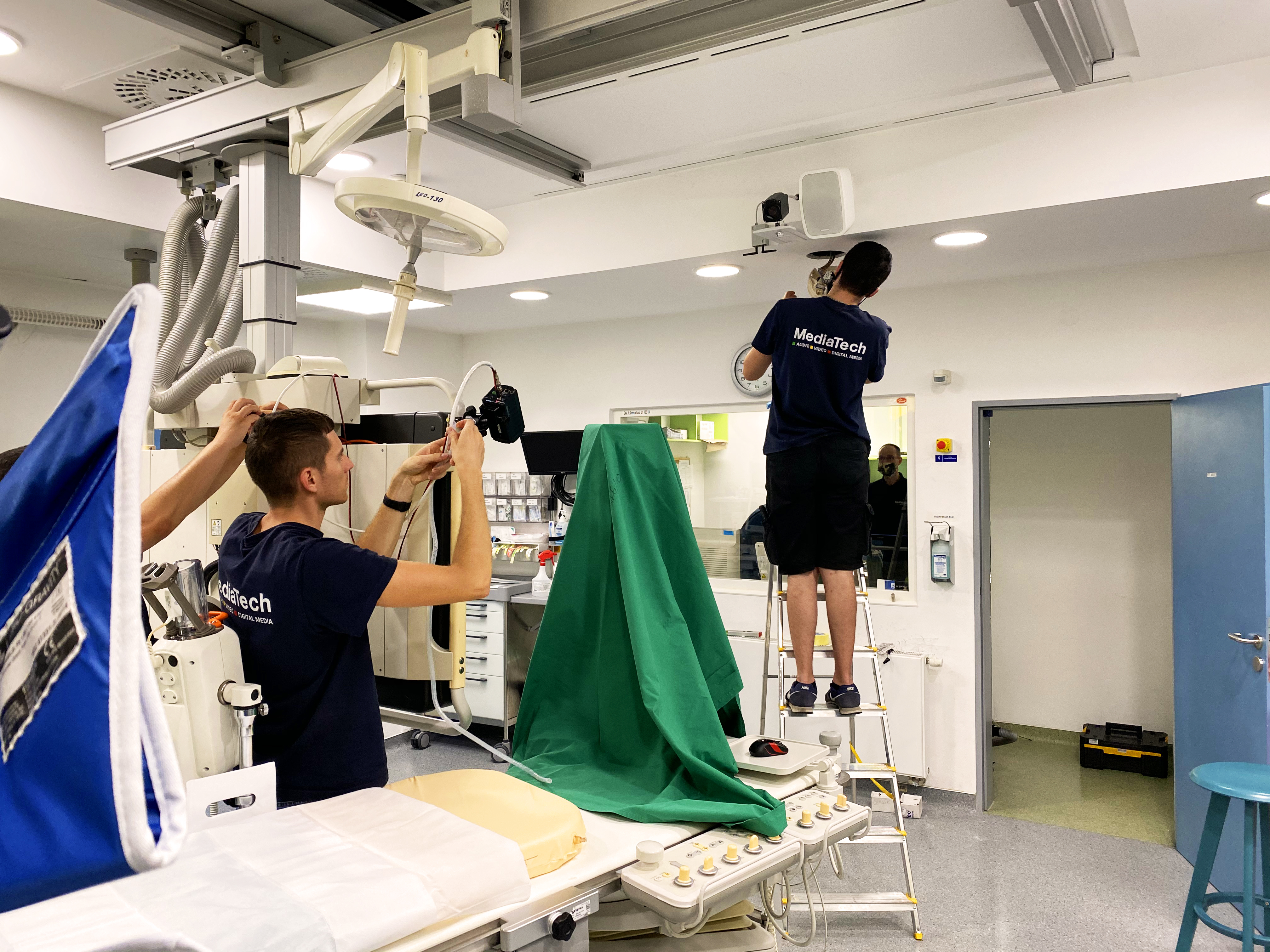
During implementation, the consultant provides supervisory participation, meaning inspection of key moments that cannot be reversed later. This applies especially before suspended ceilings and walls are closed.
The AV consultant does not actively enter the building permit phase or the occupancy approval phase, although their documents are included as attachments in both.
Four documents that an AV consultant delivers into a construction project
These outputs are concrete documents that belong in the construction project. They are documents received by the architect, the electrical designer, the general contractor and the building authority.
AV concept for the architectural design. A high-level document that defines what the AV layer in the building will do and what spatial requirements it will have. It includes the layout of technical rooms for AV racks, main cable routes, preliminary structural requirements for suspension points and cooling requirements for technical rooms. This document is handed over to the architect, who incorporates it into the architectural design.
Detailed AV design (DPR — AV section). Full project documentation for the AV layer. It includes floor plans with the location of all AV equipment, cabling drawings, connection diagrams, structural assessments of suspension points, equipment specifications and technical data sheets. It is an equivalent discipline to the electrical or HVAC design.
Coordination drawing with electrical and low-voltage systems. A document that captures the points where the AV layer meets other trades, such as shared cable routes, power points for AV equipment, PoE circuits and network interconnections. The coordination drawing defines who pulls what and where the trades will not conflict with each other. Without this document, conflicts will only be resolved on site.
Supervisory participation during implementation. This is not a document, but a service. The AV consultant is physically present during key moments of implementation. Before cabling is pulled, they approve the routes. Before suspended ceilings and walls are closed, they check whether boxes, outlets and suspension points are in the correct positions. During acceptance of the electrical installation, they confirm that the power supply matches the specification.
Division of responsibility — who is responsible for what
In a construction project, the AV layer is handled by five different roles. When it is not clear who is responsible for what, conflicts arise — and they are resolved at a higher cost and with delays.
- The architect is responsible for the layout of the space, the aesthetic integration of visible AV elements, such as the placement of loudspeakers, touch panels and displays in the interior, and for ensuring that the AV concept does not conflict with the overall design.
- The electrical and low-voltage designer is responsible for high-voltage power supply for AV equipment, structured LAN cabling, circuit sizing and PoE infrastructure.
- The AV consultant is responsible for the AV layer concept, equipment specification, AV cabling for audio, video and control, structural requirements for suspension points, and coordination with the electrical designer and architect.
- The general contractor is responsible for coordinating all trades, maintaining the schedule and carrying out the physical implementation. The AV consultant coordinates the content; the general contractor coordinates the construction.
- The AV integrator enters during the implementation phase, supplies and installs the technology, calibrates the system and hands it over to the operator.
Typical conflicts solved by this division of responsibility include:
A suspension point for a projector. The structural requirement is formulated by the AV consultant: “a suspension point for a projector weighing X kg and with a dynamic load of Y is required at this location.” The structural engineer assesses it and issues a statement. The architect incorporates it into the construction documentation. The general contractor ensures installation. Without this chain, it often happens that after construction the projector cannot be suspended where it was supposed to be, because the ceiling was not prepared for it.
The position of a loudspeaker in a suspended ceiling. The AV consultant determines the acoustically correct position. The electrical designer includes the power point and cabling in their design. The architect confirms that the position is aligned with the suspended ceiling design. Without coordination, the acoustically correct position may end up in an expansion joint or in a recessed light fixture.
Network architecture for a Dante system. The AV consultant defines the network capacity, VLAN segmentation and PoE range required by the system. The electrical designer and IT designer incorporate these requirements into the LAN design. Without this coordination, the AV system may not work after construction is complete because the corporate network was not prepared for it.
Decision calendar: which decision belongs to which moment
This is the section that a project manager can print out and use as a checklist. Each milestone has one specific question. If you do not have the answer, something is missing.
During architectural design (T-12 to T-9 months before handover):
“Does the architectural design include reserved technical rooms for AV racks, with maintenance access and properly sized cooling?”
If not, AV racks will end up in random places under staircases, in service shafts or in rooms that nobody planned as technical spaces. Maintenance then becomes difficult and cooling is improvised.
During the electrical and low-voltage design (T-8 to T-6):
“Has the electrical designer received from the AV consultant a list of power points, PoE circuits and structured cabling specifications for AV?”
If not, the electrical design does not reflect the real requirements of the AV layer. Power points are then added as design changes, and the network infrastructure is discovered on site instead of being designed properly.
During structural assessment (T-7 to T-6):
“Does the structural engineer have a list of suspension points, their weight and dynamic load for projectors, line array systems, cameras and displays?”
If not, suspension points will not make it into the structural documentation. Once the ceiling is complete, their preparation has to be solved with additional structures, which are visible, expensive and often aesthetically unacceptable.
Before suspended ceilings are closed (T-3 to T-2):
“Was the AV consultant present during the inspection before the suspended ceilings were closed, and did they confirm that boxes, outlets and suspension points are in the correct positions?”
If not, the risk of discovering conflicts after closure is high. Remediation in a finished interior means cutting into surfaces and delaying the project.
Before the interior is completed (T-1):
“Have the final positions of visible AV elements, such as displays, touch panels and controllers, been approved by the architect and the AV consultant?”
If not, the AV integrator will either improvise during installation, or the positions will be changed at the last minute with the risk of additional construction work.
During occupancy approval / handover (T):
“Is the AV layer being handed over together with the other trades, and does it have handover documentation: as-built documentation (DSPS), commissioning protocol and operator training?”
If not, the AV system is accepted separately later and often without proper documentation. This later affects warranty claims, maintenance and upgrades.
These are six questions a project manager can ask at any stage of construction. If they do not have a clear answer to any of them, AV coordination in the project is either missing or fragmented across roles, with nobody truly owning it.
How to recognize that your construction project has forgotten AV
Three concrete signals that the construction is running without proper AV coordination and that quick intervention is needed:
The execution documentation does not contain a separate AV section. If the DPR includes sections for architecture, electrical, low-voltage and HVAC, but no separate AV section with its own drawings and specification, the AV layer is being handled through low-voltage systems or interior design. That is not enough. Low-voltage design does not cover acoustics, structural requirements for suspension points or AV equipment specification.
The electrical designer has not received a power specification for AV equipment. If the electrical design does not show power points for AV racks, projectors, cameras and displays, it means the electrical designer did not receive these requirements from the AV consultant. AV equipment is then powered improvisationally from the nearest socket, often incorrectly sized.
The general contractor does not have AV in the list of coordinated trades. If the construction schedule does not include AV coordination as a separate item with its own milestones, the AV layer is perceived as a “final installation”. Something that will be added at the end. This is exactly the situation this article warns against.
If even one of these applies, the AV layer will be added after construction is complete, with compromises in quality, higher costs and delays.
Frequently Asked Questions
What if the project is already underway and we did not have an AV consultant?
It depends on the stage of the construction. If the suspended ceilings have not yet been closed and the wall plastering has not been completed, involving an AV consultant still brings significant value, because cabling and boxes can still be added. If the interior is already finished, the AV consultant will not be able to save everything, but can design a solution that minimizes construction work. The sooner the problem is identified, the more room there is for correction.
How much does AV coordination cost as a service?
AV coordination is typically billed as a percentage of the AV part of the project, or sometimes as a fixed fee depending on the scope. The price covers all four outputs: the concept, the detailed design, the coordination drawing and supervision during implementation. For projects above a certain value, typically tens of thousands of euros for the AV part, the investment in coordination pays back by preventing construction mistakes that would otherwise have to be corrected later.
Can the AV consultant and AV integrator be combined in one company?
Yes, and in most projects this works well. The advantage is continuity. The company that designed the project also implements it and knows all the details. In larger public projects, however, these roles are sometimes separated due to public procurement rules. The design is assigned to an independent consultant and the implementation is then tendered.
What if the building is being designed by a small studio without AV experience?
That is exactly when an AV consultant is most needed. The architect does not have to be an AV expert. But the project needs an AV layer designed by a specialist and coordinated with the other trades. In this situation, the AV consultant adds the missing expertise and communicates with the architect in their language: project documentation.
Who hires the AV consultant? The investor or the general contractor?
Most often, the investor hires the AV consultant directly, because the AV consultant works before the general contractor is selected. In some projects, the architect orders the AV consultant as part of their documentation. If the general contractor hires the AV consultant, it can work, but there is a risk. The general contractor is interested in fast and cost-efficient implementation, while the AV consultant should work in the interest of project quality, which can sometimes create tension.
The AV layer in a commercial building is infrastructure that belongs in the construction project from the very beginning. Bringing an AV consultant into the project at the right stage, with concrete documents and a clear division of responsibility, is the difference between a project implemented according to the original intent and a project that, after completion, had to adapt to whatever space was left.
If you are preparing a new-build or a larger renovation with an AV layer and want to be sure that the construction project takes AV into account from the start, an AAVS audit in the early phase will assess the readiness of the project, identify missing outputs and propose how to add AV coordination before irreversible conflicts arise.
MediaTech Central Europe, a.s. +421 220 999 700 | mediatech@mediatech.sk