How to Eliminate Microphone Squeal and Feedback in a Hall
Reading time: 7 minutes

Quick summary
Acoustic feedback is a sign of poorly functioning audiovisual infrastructure and poses a direct risk to an event’s reputation. A professional design prevents it through digital signal processors (DSP), notch filters, automixing algorithms, and precise calculation of gain before feedback (GBF). The result is a seamless event with consistently high speech intelligibility in accordance with IEC 60268-16.
There are moments when a technical audio failure is more than an inconvenience—it becomes a reputational crisis. When a high-pitched microphone squeal cuts through the hall at such a moment, the audience’s attention collapses in a single second.
Microphone squeal is not the speaker’s fault for holding the microphone incorrectly. Nor is it an unavoidable imperfection of a live event. It is a sign of dysfunctional audiovisual infrastructure, exposing the organiser’s level of preparation at the very moment when the audience’s attention must not be disrupted.
From a physics perspective, this is a feedback loop. Sound from a loudspeaker enters a microphone, is amplified by the system, and is emitted through the loudspeaker again. The cycle repeats several times in a fraction of a second. It continues until the system reaches its limit, producing destructive squealing or low-frequency howling.
This phenomenon is not random. It occurs whenever the system’s GBF (Gain Before Feedback) parameter—the maximum possible system gain before feedback begins—is calculated incorrectly or exceeded.
GBF is a physical quantity that can be calculated from the placement of microphones and loudspeakers, the directivity of the components, and the acoustic properties of the room. A professional conference-infrastructure design begins with this calculation.
Why manually reducing the volume does not solve the problem
The standard response of an untrained operator when squealing begins is to immediately lower the master volume on the mixing console. This stops the feedback, but creates a secondary problem that is often more serious than the original one.
The Speech Transmission Index (STI, defined by IEC 60268-16, where a value below 0.5 is considered inadequate for conference spaces) drops to a critical level.
Listeners in the middle and rear rows can no longer understand the speaker. If the operator tries to restore the original volume, the system immediately begins to resonate again. The organiser is left in a stalemate between two bad options: audible feedback or sound that fails to meet the required speech-intelligibility level.
Reducing the volume to control feedback is like slowing a car by switching off the engine.
Buying a basic consumer-grade analogue mixing console without DSP capabilities confines the venue to precisely this compromise.
From a TCO (Total Cost of Ownership) perspective, this means that the space fails to fulfil its basic function. The investment in the hall itself, rental costs, speaker fees, and participants’ time—the entire value of the event—is undermined by a failure at the infrastructure level.

The mathematics of open microphones: The NOM rule
A critical variable in panel discussions and moderated events is the number of microphones open at the same time. In technical literature, this parameter is known as NOM (Number of Open Microphones), and its effect on system stability follows a precise logarithmic relationship.
The rule is simple: every doubling of the number of open microphones reduces the available GBF by 3 decibels, according to the relationship NOM attenuation = 10·log10(NOM).
In practice, if a system with one microphone has a stable margin of, for example, 20 dB before feedback, that margin falls to 17 dB with two microphones, 14 dB with four, 11 dB with eight, and 8 dB with sixteen. Twenty open microphones represent a loss of 13 dB compared with a single-microphone configuration.
This mathematical relationship has two practical consequences.
First, any panel discussion with six or more microphones that is not equipped with automatic mixing operates continuously in a high-risk zone.
Second, the intuitive solution—“let’s add another microphone so the speaker can be heard better”—has exactly the opposite effect. The system loses headroom and the likelihood of feedback increases.
A professional approach solves this problem by integrating automatic mixing algorithms directly into the DSP processor. The system continuously determines who is speaking, gives the active speaker full level, and attenuates the other microphones within a fraction of a second. This keeps the effective NOM as low as possible and maintains GBF at a safe level without manual intervention by a sound engineer.
DSP processing: Computing power as architecture
The difference between a dysfunctional hall and professionally designed conference infrastructure lies in processing power. Modern audio architecture is controlled by DSP processors (Digital Signal Processing) that operate in real time with latency below one millisecond.
Feedback control in a DSP environment takes place simultaneously on two levels.
The first is parametric equalisation and notch filtering. During installation, the integrator analyses the hall’s resonant frequencies using a ring-out procedure—a controlled process of raising the system gain to the feedback threshold. Extremely narrow notch filters are then applied at the identified resonant frequencies, removing only the specific frequencies at which the room tends to feed back from the system’s frequency response.
The bandwidth of such a filter is typically only a few to a few tens of hertz, making it virtually imperceptible to human hearing. The narrow bandwidth leaves the speaker’s overall vocal tone intact while giving the system several additional decibels of headroom.
The second level is Advanced Feedback Suppression (AFS). Advanced algorithms monitor the audio signal in real time and look for acoustic patterns characteristic of emerging feedback. If the system detects the onset of oscillation, the AFS module can deploy a dynamic filter within a few milliseconds—typically less than 10 ms, depending on the implementation—and suppress the frequency peak before it develops into audible squealing.
The audience remains completely unaware that anything happened. This is precisely the difference between a professional AV system and one that is merely trying to survive.
Reference installation: Hilton DoubleTree Bratislava
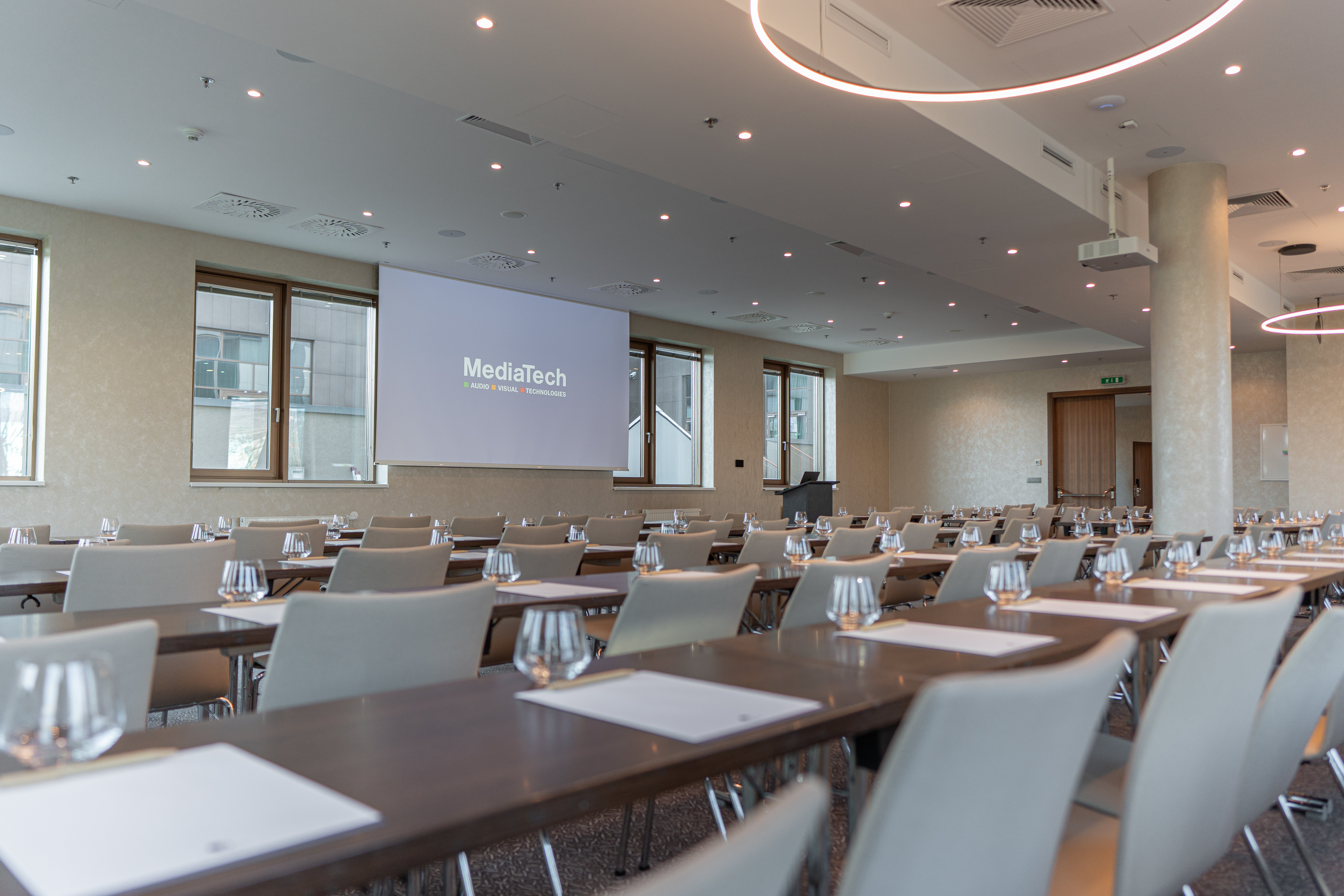
A real-world example of these principles is the comprehensive AV installation in the Hilton DoubleTree Bratislava conference facilities. MediaTech integrated a high-performance sound reinforcement system, wireless microphone systems for speakers and panel discussions, video-projection surfaces, videoconferencing solutions, and intuitive touch controls.
A specific requirement of this project was compliance with Hilton’s global protocols for audiovisual quality in conference facilities. International hotel brands do not treat AV as a simple purchasing item, but as a risk that must remain under control.
The solution also includes an AudioPressBox interface, giving media organisations and external technical teams fast, clean access to the audio signal during press conferences. This is precisely the kind of detail that matters when television crews or radio reporters enter the hall—and precisely the kind of detail that is overlooked in a risk-prone design.
Quality assurance based on international standards
Eliminating feedback requires perfect coordination of several factors. Loudspeaker directivity and coverage patterns must be matched to the microphone characteristics. The room’s acoustic properties—including reverberation time, low-frequency resonances, and the ratio of direct to reflected sound—must be incorporated into the design before installation. The final DSP calibration must be performed using real measurements, not theoretical assumptions taken from catalogue tables.
This work belongs in the hands of appropriately qualified AV integrators, not electricians or general IT service providers.
MediaTech is a systems integrator that holds PSNI Global Deployment and Global Service Certification. These certifications ensure strict adherence to international protocols for design, system phasing, calibration, and ongoing technical service across projects in different countries.
Tender engineering based on these standards shifts the discussion away from the lowest purchase price and towards the more important question every buyer should ask before signing a contract: how does the design ensure zero failures during mission-critical events?
If a supplier cannot answer this question specifically, the tender is merely a signature beneath a future reputational incident.