All-in-one video panels vs DSP microphones: Comparison of sound quality, costs, and suitability for different spaces
Reading time: 5 minutes
Quick Summary
The choice between a compact All-in-one video panel (video bar) and a distributed audio system with a DSP processor is influenced by the physics of the space. While video bars are ideal and cost-effective for small “Huddle rooms” of up to 4 people, in larger and glass-enclosed meeting rooms they fail due to acoustic attenuation and reverberation.
If you are in the process of modernizing the video conferencing technology for your corporate premises, you are most likely facing an architectural dilemma.
One salesperson shows you a neat oblong All-in-one panel, in which everything – camera, speaker and microphone – is integrated into a single piece of hardware under the display. The other one shows you a structural network of inconspicuous microphones in the ceiling connected to devices in the IT rack, known as a “DSP processor”.
A question we often receive at MediaTech is: “Do we have to install acoustics up to the ceiling in the meeting rooms? Isn’t an All-in-one solution enough?”
Both technologies have their place in the market. However, the decision should not be based on design, but on physical conditions and the overall return on investment. Here is a technical comparison.

All-in-One video bars: When are they the ideal choice?
This concept has achieved global success thanks to its straightforwardness. One USB connection, one power cable and quick installation of a visually clean strip under the company TV.
Spaces suitable for video bars
We recommend them without hesitation in architectural terms for so-called “Huddle rooms”. These are small, quiet cells designed for 3 to 5 people. The table in them often adjoins the wall with the screen on one side, while the speaker on the opposite end is no further than two meters away.
Where does the technical problem arise?
The video bar works on a physical compromise. One piece of equipment must fulfill the role of both ears (omnidirectional microphone) and mouth (speaker) in a plane a few centimeters apart. Trying to deploy this system in a long 8-meter conference room or a glass-enclosed room with hard materials presents two major problems:
Microphone struggles with its own speaker: If people in the room and on the other side of the conversation are speaking alternately, the microphone must aggressively filter the super-loud sound from its own speaker to avoid echoes. As a result, it often “cuts off” the beginnings of words because it cannot transmit sound from both sides at once (it works like an old walkie-talkie where only one person can speak).
Poor intelligibility at a distance: A microphone that is thus muffled by its own speaker and at the same time struggles with air conditioning noise or reflections from windows can no longer clearly capture the voice of a person sitting six meters away at the opposite end of the table. The sound gets lost and forces people to unnaturally raise their voices.
Physics cannot be fooled. A universal microphone mounted on a wall cannot clearly capture a continuous dialogue between two people six meters apart in a room with medium reverberation (RT60).”
Distributed Audio with DSP: Why Large Meeting Rooms Require This Approach
For the architecture of large meeting rooms that really matter, a completely different logic comes into the projects – distributed AV engineering defined by precise standards like the PSNI Global Alliance.
Precision Ceiling and Beam Vase Technology
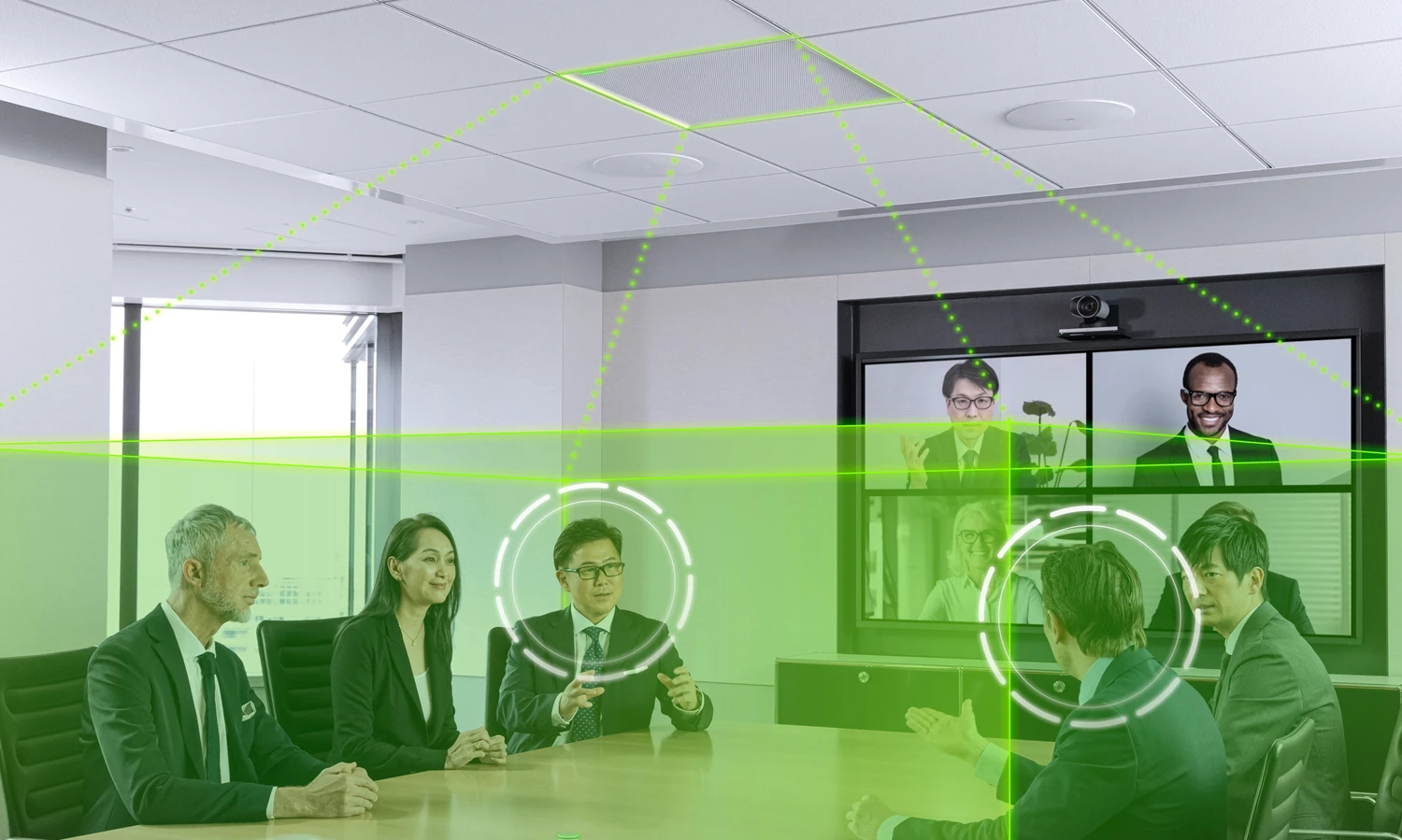
In this architecture, ceiling and table matrix technology reigns supreme. Multiple separate microphone elements placed high in the ceiling focus their attention on a so-called beam, below the speaker speaking, respecting the sound source.
The Heart of the System: Digital Signal Processor (DSP)
All this complex audio mathematics travels from the interconnected points to the hardware brain of the operation – the rack-mounted DSP processor. This device, with dozens of software filters, calculates echo foci (Acoustic Echo Cancellation – AEC), automatically compensates for background noise suppression, and sends the other party a crystal-clear, echo-free recording.
Audio reproduction also distributes spoken words from sophisticated, ceiling-mounted speakers at an even frequency throughout the room. This provides listeners with a smooth, confident sound even at quieter speech, just as surround audio in a commercial cinema does.
The CFO’s Determinant: Total Cost of Ownership (TCO) and the Risk of Electronic Waste
When approving purchases, companies often make the wrong decisions based solely on the comparison of initial costs (CapEx), where an All-in-one video bar is logically cheaper than a complex DSP. But if you apply real life cycle metrics (Life Cycle Management) to the equation, the math changes drastically.
Technologies do not become obsolete at the same pace:
- Cameras and codecs are constantly in a state of innovation and become technologically obsolete after only 4 to 6 years (a leap in resolution, changes in connectivity, and the software requirements of Teams/Zoom communicators).
- However, high-quality ceiling microphones, speakers, and installed cabling, due to the immutable laws of frequencies and physics, retain their leading edge for 10 to 15 years.

The shortsightedness of investing in an All-in-On strip
If you decide to scale up such a compact unit to key spaces, you have to accept the tax for integrating an “all-in-one”. The moment the camera becomes visually outdated or the integrated Android processor loses support from Microsoft for updates, you have a problem.
To revive the room with the latest image standard, you have to tear down and dispose of the entire device together with the speaker and microphone, which were actually fully functional. The entire investment ends up in the electrical waste.
The triumph of a modular solution with an extended lifespan
If you invest correctly in distributed ceiling audio and a separate DSP processor when modernizing for medium-sized conference rooms, the “AV Refresh” scenario will cost you half as much.
After the camera sensor fails in 5 years, you only need to replace a small camera component (new optics and computing core) for a fraction of the total cost budget. The expensive professional audio hidden in the ceiling, which was calibrated according to AV9000, remains intact and performs its role in the smooth running of the meeting room without the technician blinking for another decade.
In this way, there is one hundred percent protection of real company investments and long-term stress-free calls for employees.