Educational Institutions and AV Standardization: How to Bring 20 Lecture Halls Under One Standard
Reading time: 14 minutes
Quick Summary
- Why some universities have AV chaos while others have a structured system
- Three templates that organize an entire university AV portfolio
- What a standard lecture hall should include in 2026
- Public procurement: why choosing the lowest price can be a risk for the institution itself
- Is it worth paying more for a system that appears more expensive at first?
- How to recognize a supplier who understands the needs of a university
- Two projects that demonstrate these principles in practice
- Frequently Asked Questions
A university with a large number of lecture halls has only two possible approaches to managing its AV environment.
Either each room is designed individually: with different suppliers, different technologies, and different control methods.
Or the university has an AV standard that can be replicated. A lecturer enters any lecture hall and can use it immediately without additional training.
These two approaches show how differently educational institutions handle the procurement of AV technology. Ultimately, they determine whether a university pays for audiovisual equipment once — or repeatedly spends the same budget every few years replacing inconsistent solutions.
The real success of an AV implementation is not determined by choosing specific speakers or displays. It starts much earlier, with the quality of the requirements specification itself.
Why Some Universities Have AV Chaos While Others Have a System
Imagine a university that equipped its first modern lecture hall in 2010. At the time, a tender selected the supplier offering the most suitable solution at the best price. Two years later, the university needed a second lecture hall. A new tender was launched, and another supplier won with the most competitive offer at that time. And the cycle continued.
Years later, the university has twenty lecture halls and six different AV systems — each with completely different controls and operating procedures.
This situation did not happen because someone made a mistake. It is simply the natural result of treating every room as an isolated project rather than as part of a larger system.
In practice, two groups pay the price for this approach:
The lecturer at the front of the room, who teaches in three different lecture halls and has to remember a different procedure for starting the display, projector, and audio system before every lecture.
The IT specialist behind the scenes, who instead of managing one consistent platform is maintaining six different technology environments. They need to keep different spare parts in stock and find a specialist familiar with each individual system whenever something fails.
On the other side are institutions that have chosen a unified internal standard. A lecture hall of a certain level looks and operates the same way in every building, and the IT department manages one predictable and consistent system.
This approach also simplifies procurement significantly. Instead of tendering every room separately, the university can establish a framework agreement covering all future lecture halls according to clearly defined standards and requirements.
The difference between these two approaches may appear to be a minor technical detail during procurement. In everyday university operations, however, it can determine how much time, money, and energy is unnecessarily lost.
Three Templates That Bring Order to an Entire University AV Portfolio
The way out of AV complexity starts with dividing classrooms into three levels based on their size and purpose. Instead of designing something new for every renovation, the university creates three technology packages that can then be repeated and standardized.
Level 1: Seminar Rooms for Up to 30 People
These are classrooms for smaller groups, practical exercises, or thesis presentations. The lecturer typically presents from their own laptop and may occasionally need to connect a remote participant through a video call.
What the package includes:
An interactive display or large screen with wireless connectivity, a simple microphone solution for voice transmission, a USB camera, and one central control point.
Level 2: Lecture Halls for 30 to 150 People
This is the most common type of space at most universities. The majority of lectures take place here. The key requirements are clear speech intelligibility in every seat and reliable support for smooth hybrid teaching.
What the package includes:
A high-performance projector or large LED display, a properly designed sound system covering the entire room with a target speech intelligibility rating of STI ≥ 0.70, and a wireless microphone for the lecturer.
For students joining remotely, the room includes a ceiling-mounted beamforming microphone system to capture audience questions and a camera that automatically follows the speaker’s movement.
The entire system is managed by an AEC processor for echo cancellation and a touchscreen control panel where users simply select one of five predefined operating modes.
The IT department can also monitor the entire room remotely through its management platform (such as Crestron XiO Cloud, Q-SYS Reflect, or Biamp SageVue).
Level 3: Large Lecture Theatres and Conference Halls for More Than 150 People
These are the heart of faculties — spaces used for inaugurations, graduation ceremonies, and major conferences. In addition to standard lectures, they must support live streaming, simultaneous interpretation, and demanding hybrid events.
What the package includes:
A high-end audio system designed specifically for the acoustics of the hall. A complete microphone package covering everything from lectern microphones and wireless handheld microphones to ceiling-based audience audio capture.
The system includes multiple cameras that can be switched between, integration with interpretation booths, and two mixing consoles for the audio engineer: one fixed and one portable.
Because large lecture theatres are a highly complex topic, we cover them in a separate article focused on corporate auditoriums and hybrid conferences.
What Does Predictability Bring?
Without this classification, every room becomes a separate puzzle. A three-level standard reduces the entire process to three proven configurations.
At universities, the typical distribution is approximately:
- 70% small seminar rooms,
- 25% medium-sized lecture halls,
- less than 5% large auditoriums.
This allows university management to know exactly how much modernizing one Level 2 lecture hall will cost. With a defined budget, they can plan how many rooms can be upgraded this year and how many in the next.
This level of predictability is impossible when every lecture hall is treated as a completely unique project.
What Should a Standard Lecture Hall Include in 2026?
For a medium-sized lecture hall to operate reliably, its technical infrastructure must be built on four key pillars. Each layer has a clearly defined role in the university’s daily operation.
1. Display Layer (What Students See)
A large LED wall has the advantage of long service life. It can operate continuously for eight to ten years and remains clearly visible even when sunlight enters the room. A traditional projector is usually less expensive, but after five to seven years it typically requires a light source replacement. It also loses contrast in bright environments.
Regardless of which display technology is selected, wireless connectivity should be available for users. If a lecturer has to search for a cable under the desk before every class, the technology will often simply not be used.
2. Audio and Microphones (What Students Hear)
Speakers must be positioned so that the lecturer can be heard equally clearly from every seat in the room. In technical terms, this means achieving a target speech intelligibility rating of STI ≥ 0.70.
In standard lecture halls, audio systems are typically implemented using ceiling-mounted speakers or, in tiered seating areas, column speakers with vertical sound steering technology known as beam steering. In longer halls, an additional speaker line may be added at the rear of the room.
The microphone package consists of three key elements:
For the lecturer:
A small wireless lapel or headset microphone, allowing the lecturer to keep their hands free and move around the room.
For students joining remotely:
A ceiling-mounted beamforming microphone that can automatically focus on a student speaking from the audience when they ask a question.
As a backup:
A standard handheld wireless microphone for situations where beamforming is not sufficient — for example, in large halls, when a student has a quiet voice, or when multiple people speak at the same time.
Without a beamforming microphone, questions from the audience cannot be properly transmitted to remote students. Someone watching online then hears only the professor’s answer but has no idea what question the student in the room actually asked.
3. Hybrid Mode (Connecting the Physical and Digital Worlds)
Streaming lectures, connecting Erasmus students, or hosting guest lecturers from partner universities abroad — hybrid teaching is no longer a luxury. It is a daily reality.
A properly equipped lecture hall requires:
- A camera that automatically follows the lecturer as they move around the board or presentation area.
- An AEC processor (Acoustic Echo Cancellation) that removes echo and ensures clear communication without feedback between both sides of the connection.
- A fixed system certified for platforms such as Microsoft Teams Rooms or Zoom Rooms.
For the lecturer, this should mean a single button on the touch panel: “Start Hybrid Lecture.” The system connects automatically to the scheduled calendar event and starts the session.
Without these elements, lecturers usually bring their own laptops, and a hybrid lecture quickly turns into a poor-quality video call.
4. Control and Remote Management (How It Is Operated and Maintained)
At the entrance of the lecture hall, there should be a simple touchscreen control panel. No complex menus and no unnecessary settings. The lecturer should see only three to five predefined options:
- Lecture
- Hybrid Lecture
- Seminar
- Power Off
With a single touch, the entire room automatically switches into the correct operating mode.
The other side of the same solution is remote management for the IT department. Through a central management platform (such as Crestron XiO Cloud, Q-SYS Reflect, or Biamp SageVue), IT teams can monitor the status of all lecture halls from a single screen in their office.
They can identify problems remotely, update software across multiple rooms at once, and schedule preventive maintenance before failures occur.
Public Procurement: Why Choosing the Lowest Price Can Also Be a Risk for the Institution
In practice, public procurement has two possible approaches. Either the only deciding factor is the lowest price, or the evaluation combines price and quality through predefined weighting criteria.
The first option may appear attractive and transparent on paper. After all, the winner is the supplier who offers the lowest price. In reality, however, this approach carries risks. This happens when the tender documentation does not include clear quality requirements because the procurement committee simply had no basis for defining them. This is the moment when it is decided whether the technology installed in lecture halls will reliably serve for the next eight to ten years — or whether it will need to be replaced much sooner.
The second approach requires more preparation, but it is precisely the one that protects the contracting authority. Price remains an important criterion, but it receives an appropriate weighting, for example 60%. The remaining part is assigned to quality criteria such as warranty and service conditions, references, equipment lifespan, or the qualifications of the implementation team.
However, for this approach to work, someone must define these quality criteria in advance. And this is exactly where the next part of this chapter begins.
Four Safeguards That Protect a University’s Investment in Tender Documentation
High-quality tender documentation acts as a filter. From the beginning, it allows only suppliers with the real capability to successfully complete the project to participate.
Below are four areas that are most often underestimated in AV procurement — along with specific requirements that should not be missing from the tender specification.
1. Origin and Traceability of Equipment
Occasionally, the market includes companies importing equipment outside official European distribution channels. For a university, this creates two risks:
Invalid manufacturer warranty.
Most brands (such as Shure, Sennheiser, Crestron, Biamp, and Q-SYS) provide regional warranties that are valid only in the country where the product was purchased.
Illegal wireless microphone frequencies.
If microphones operate on frequencies reserved for other services within the European Union, the university risks signal interference and possible penalties from the telecommunications authority.
2. Complete Design Documentation Before Installation
If an offer does not include acoustic simulations or an accurate cabling design, installation is carried out based on assumptions and experience rather than engineering data.
At a university, where AV technology is installed alongside electrical systems, HVAC, and other building infrastructure, this is a reliable way to create conflicts between different construction disciplines.
What should be included in the tender specification:
“The bidder shall submit complete project documentation before the start of implementation. The documentation must include acoustic coverage simulation of the lecture hall, network design, cabling plans, and drawings coordinated with the construction readiness of the space.”
3. Service That Does Not End with Sending a Package
A manufacturer warranty does not mean that someone will arrive and repair the system when a failure occurs. It does not include guaranteed response times, loan equipment, or remote diagnostics.
If a university with dozens of lecture halls waits a month for every repair claim to be processed, it loses valuable teaching capacity.
What should be included in the tender specification:
“The bidder shall submit a proposed service agreement (SLA) with clearly defined response times (maximum 4 hours for critical failures), an annual preventive maintenance schedule, and a guarantee of replacement hardware availability during repairs. The agreement must also include a condition that all software configurations remain the property of the university after project completion.”
4. Certifications of the People Installing the Technology
Modern educational AV systems are no longer simple electrical installations. If a company only delivers AV systems as a secondary activity alongside other services, it often lacks direct access to manufacturer support programs. Leading manufacturers such as Crestron, Biamp, and Q-SYS provide advanced technical support primarily through certified partners.
As a result, important details that specialist AV integrators consider standard practice can easily be overlooked.
What should be included in the tender specification:
“The bidder shall submit a list of the implementation team, including individual professional certifications (for example CTS or CTS-I from AVIXA, Crestron Master Programmer, Microsoft Teams Rooms Engineer, or equivalent). At least 80% of project work must be performed by the bidder’s internal team.”
What Happens When Quality Criteria Are Missing from the Tender?
If these requirements are not included, the lowest price becomes the only deciding factor. In everyday university operations, this quickly leads to four problems:
Technical inconsistency.
After three separate procurements, the university ends up with three different systems that cannot communicate with each other and cannot be managed centrally by IT.
Expensive training and service.
With every configuration change, users and IT staff must learn a completely new system. Over a seven-year period, these costs reliably eliminate any savings achieved through a lower purchase price.
Hybrid teaching exists only on paper.
Without a fixed and certified configuration, lecturers must manually start and configure everything. If the process takes 5–10 minutes, many lecturers will simply stop using it, and remote students will lose access to the session.
Searching for the right technician every time.
When a failure occurs, a different technician may arrive each time and must first understand how the system was designed.
Who Should Write the Specification and When Should Experts Be Consulted?
Procurement committees at universities are typically made up of IT staff, facility management representatives, and faculty members. They are experts in their own fields, but they cannot reasonably be expected to also be specialists in the latest developments in professional audio and video technology.
Public procurement legislation therefore provides an open option: preliminary market consultations.
This is an official and transparent process where the committee consults market experts before launching the tender. The purpose is to understand which technical standards are currently common and what risks should be considered during procurement.
The entire process must be communicated transparently so that all potential suppliers have equal access to the information. A consulting company may participate in the future tender, but it does not have to.
An experienced integrator can help the committee correctly define classroom categories, identify hidden technical risks, and structure the procurement so that submitted offers are evaluated according to their true long-term value.
Is It Worth Paying More for a System That Appears More Expensive at First?
When two proposals are compared side by side, a unified AV standard is typically 10–20% more expensive at the initial purchase stage than a solution designed separately for a single room.
The difference usually comes from management features and higher-quality components. If the numbers are viewed only through the lens of the immediate budget, the additional cost may appear unnecessary. In daily operation, however, the situation quickly changes.
The higher initial investment is typically fully offset by around the fourth year. Users need to be trained only once, the institution works with a single service agreement, and technology replacement can be planned systematically.
From the fifth year onward, the standardized system begins to generate real savings. Over a seven-year lifecycle, the total cost of operation and repairs can be 25–40% lower compared with a non-standardized approach.
How to Recognize a Supplier Who Understands Universities
The requirements defined in the tender documentation will eliminate suppliers who cannot demonstrate the necessary capabilities. Questions asked during discussions reveal how a supplier thinks about a specific project.
These three questions, whether asked during preliminary market consultations or during the first supplier meeting, quickly show whether the company has real experience with the university environment.
1. Do You Have Projects in Your Portfolio for Educational Institutions with Multiple Rooms?
A supplier who answers with specific examples — references, number of rooms delivered, and the type of tier-based standard implemented — demonstrates experience with this type of project and procurement process.
2. How Do You Handle Integration with University IT Infrastructure?
University AV systems are not standalone solutions. They connect to the network, use Active Directory for authentication, integrate with calendar systems for room booking, and in some cases connect with Learning Management Systems (LMS) such as Moodle or Canvas for lecture recording and content management.
A supplier with experience in these integrations will be able to provide specific and practical answers rather than generic statements.
3. What Is Your Training Model for Teaching Staff?
Without proper training, users will not operate the system as it was designed.
A good supplier has prepared short guides for each usage scenario and provides quick-start cards at the entrance of every lecture hall, allowing lecturers to start using the technology confidently without additional support.
Two Projects That Demonstrate the Principles in Practice
Aula of Aurel Stodola, Slovak University of Technology in Bratislava
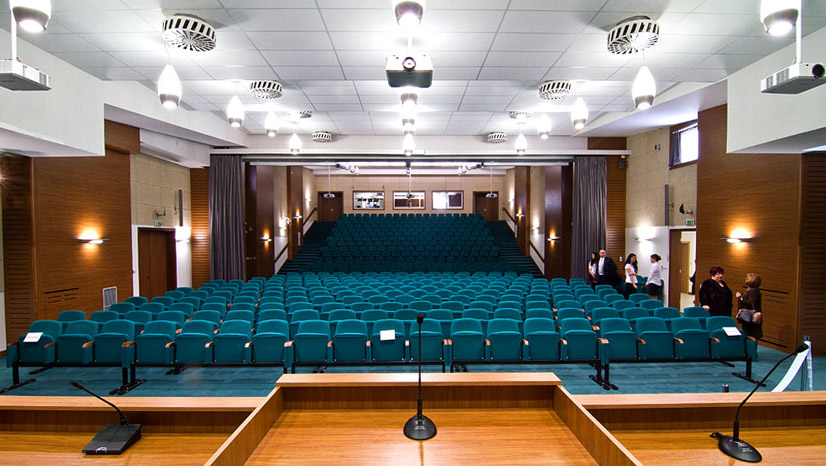
The Aula of Aurel Stodola, with a capacity of 800 seats, is an example of a Level 3 space where the system must support both regular academic operation and special events.
To accommodate these two different use cases, MediaTech designed a system with two operating modes.
Mode 1 — Unattended Mode for Lecturers
Designed for lectures and academic events where the system is operated by a lecturer without specialized technical training.
The system is activated with a single switch, and predefined scenarios automatically start the projection, microphones, and audio system in the correct configuration.
Mode 2 — Full Production Mode for Cultural and Social Events
Designed for ceremonial academic events, conferences, and performances where a technician is present and has full control over the entire system.
This mode includes management of the line array system, beamforming microphones, multiple cameras, and integration with interpretation booths.
The solution was built by MediaTech using a Yamaha MRX7-D processor with Dante technology, a Yamaha TF-RACK automatic mixing console, line array loudspeakers, and AudioPressBox technologies for signal distribution to broadcasters and media representatives.
The entire system is controlled through a central touchscreen interface.
The Aula of Aurel Stodola demonstrates that a tier-based approach is not only about cost optimization. The same installation can support two completely different operating scenarios without compromising either one.
Faculty of Health Sciences Auditorium, Slovak Medical University in Banská Bystrica
The auditorium of the Slovak Medical University in Banská Bystrica is an example of an institution where AV was planned as part of a broader ecosystem rather than as an isolated room installation.
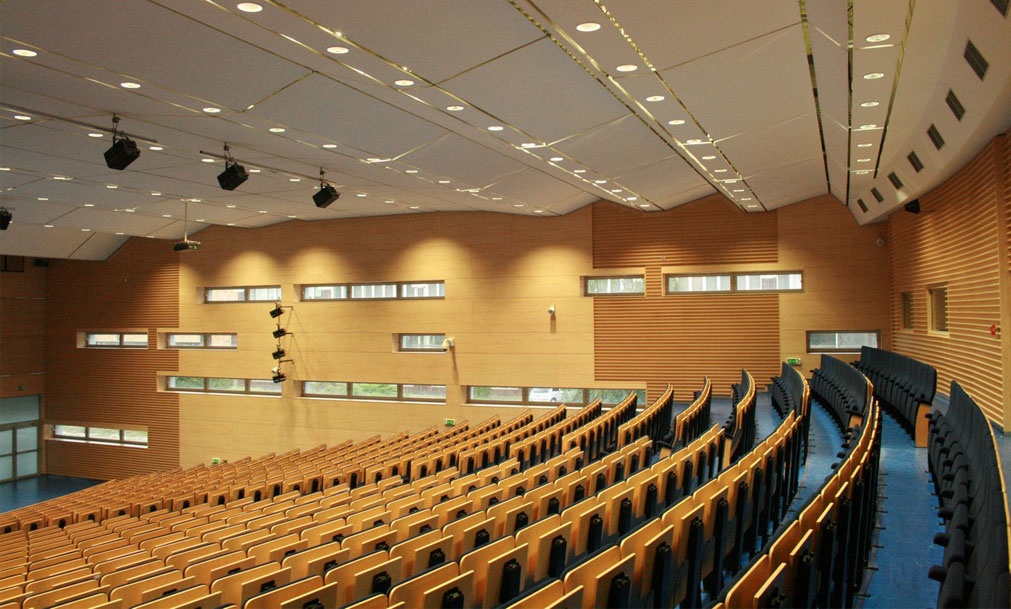
The auditorium serves traditional academic purposes — lectures, graduation ceremonies, and formal academic events — while also supporting technologically demanding formats, including live broadcasts of surgical procedures from clinics across Slovakia and Europe.
Remote collaboration and telepresence are a standard operating mode in this auditorium, not an exception.
From the perspective of this article, the project illustrates another important principle of AV standardization: the system architecture must be designed with future growth in mind.
The auditorium was designed to support two-way communication with high speech intelligibility, integration with interpretation booths, and a control system that allows operators to manage new events without extensive training.
When technologies change, the system can be expanded rather than rebuilt from scratch.
Frequently Asked Questions
How much does a standardized AV solution cost for a university with 20 lecture halls?
The cost depends on the ratio of different room levels within the portfolio.
For a university with 50 classrooms distributed in a 70/25/5 ratio, the investment in a fully standardized AV portfolio typically ranges between €1.5 million and €4 million.
The key factor is whether the portfolio is built all at once or gradually. With a framework agreement where 5–7 rooms are equipped every year according to the same standard, the total investment remains similar but is distributed over a period of 5–7 years.
What is a tier-based standard and how many levels do we need?
A tier-based standard means dividing the AV portfolio into levels according to room type, with each level having its own predefined technology package.
For most universities, three levels are sufficient:
- Seminar rooms (Level 1)
- Lecture halls (Level 2)
- Auditoriums (Level 3)
For larger institutions with specialized spaces — such as AV-equipped laboratories, clinical simulation rooms, or studio facilities — a classification with 4–5 levels may be more appropriate.
Can consultation before public procurement conflict with procurement rules?
No, provided that the process is transparent.
Public procurement legislation explicitly allows preliminary market consultations with industry experts before launching a tender. The condition is that the consultation is documented, its results are publicly available, and all bidders have equal access to the information obtained.
A consulting supplier may participate in the subsequent tender, but it does not have to. Its involvement must be publicly traceable and cannot be used to unfairly favor the company.
In practice, consultations are often conducted with two or three independent suppliers to ensure a balanced perspective.
How is hybrid operation managed across multiple rooms simultaneously?
At a university where hybrid lectures take place simultaneously in dozens of rooms, success depends not only on the equipment installed in each room but also on network and server capacity.
Each hybrid lecture places a load on platforms such as Microsoft Teams or Zoom. Running 10–15 hybrid sessions simultaneously can create significant demands on the university’s internet infrastructure.
Before implementing hybrid teaching across the entire AV portfolio, a network audit is recommended, followed by capacity upgrades if the existing infrastructure is insufficient.
What is the lifespan of an AV system in an educational institution?
Professional-grade main components — such as amplifiers, speakers, control systems, and displays — typically have a lifespan of 8–12 years.
Microphones and cameras are usually replaced sooner because their technology evolves faster, typically after 5–7 years.
Projection technology generally has the shortest lifespan:
- Laser projectors: approximately 5–7 years
- Lamp-based projectors: approximately 3–5 years
Centralized control platforms such as Crestron, Q-SYS, or Biamp provide an advantage because their software is continuously updated, allowing hardware investments to remain useful for a longer period.
How should we start if we currently have AV chaos and want to move toward standardization?
The first step is an audit of the existing AV portfolio.
The audit identifies:
- the condition of each room,
- which components can be retained during standardization,
- which systems require replacement.
Based on the audit, a consolidation plan is prepared, typically over a 3–5 year period, synchronized with planned renovations and budget cycles.
With a properly designed roadmap, the university does not need to replace everything at once. Existing functional components can be integrated with centralized management and gradually replaced during planned upgrade cycles.
If you are considering AV portfolio standardization, modernization of lecture halls, or the design of new conference and auditorium facilities, the first step is assessing the current situation and operational requirements.
Order an AAVS audit for your institution — an initial assessment of your AV portfolio, including documentation of the current state, identification of priorities, and a proposed consolidation or modernization plan.
Or request a consultation before public procurement — expert support in defining functional and quality criteria that allow submitted offers to be evaluated according to their true long-term value.
MediaTech Central Europe, a.s.
+421 220 999 700 | mediatech@mediatech.sk