Hotel Sound System and Multi-Zone Control: Why the Decision Is About Architecture, Not Loudspeakers
Reading time: 19 minutes
Quick summary
- How hotel sound systems differ from restaurant sound systems
- Six zones under one roof, six different tasks
- A centralized system or island-on-island zones
- Who actually controls the individual zones
- Integration with other hotel systems
- Music licensing for hotel operations
- Three situations: a new hotel, renovation, modernization of an existing system
- How to recognize a supplier who understands hotels
- Two projects that illustrate the principles in practice
- Frequently asked questions
A hotel is unusual in commercial AV because it is not one space. It is a collection of different spaces under one roof that open, close and are used at different times, serve different types of guests and expect different things from the sound system. The reception desk has a different operating mode at eight in the morning than the restaurant, whose mode differs from the wellness area, which in turn has a different mode than the conference room.
That alone would not be a problem. The problem is that decisions about hotel sound systems are very often made gradually, room by room, tender by tender. Reception in one year, restaurant in the second, conference spaces in the third. Each project gets its own supplier, technology and control interface. After five years, the hotel has five separate AV systems that do not know about each other, are not controlled in the same way and are serviced through five different contracts.
This guide shows why the decision about hotel AV should not be treated as a decision about sound reinforcement, but as a decision about operational thinking. And why a hotel dealing with renovation or modernization has a unique opportunity that a new build does not: to see first-hand what works in the current setup and what does not.
How hotel sound systems differ from restaurant sound systems
In a single restaurant, the acoustic and operational task is clear. One space, one type of guest, one daily profile, one service team. In a hotel, each of these variables is multiplied by the number of zones, and every added zone brings a new combination that does not exist elsewhere.
The reception operates from 00:00 to 24:00 with minimal staff at night. The lobby has two or three peak modes per day. The restaurant has different profiles for breakfast, lunch and dinner, each with a different noise dynamic and a different expected music level.
The wellness area operates from eight in the morning to ten in the evening with a completely different acoustic requirement. Here, music should not fade into the background. It should rather mask other sounds.
Conference rooms are switched on according to bookings, often several times a day, and every booking has its own type of event. An event hall works on weekends for weddings and during the week for corporate events.
Each of these zones needs its sound system to fulfil a specific task. But at the same time, all these zones belong to one operator, one maintenance budget and one team that has to operate them.
This multi-zone contradiction is exactly the point where it is decided whether the hotel will have an AV ecosystem or a collection of AV islands.
Six zones under one roof, six different tasks
Before we get to architecture, it is worth naming what each hotel zone actually needs from the sound system. This layer is often skipped when selecting a system, and people assume that “hotel sound system” is one task. It is not.
Reception and lobby
The reception area is the most acoustically compromised zone in a hotel. It serves both the guest at the desk, where speech intelligibility matters, and the guest moving through the space, where music should create atmosphere without disturbing check-in conversations. These two functions compete with each other.
A practical solution is to divide the lobby into two micro-zones. A quieter one near the reception desk and a fuller one in the seating area. Without this division, the receptionist either has music that is too loud for guest conversation, or an empty-feeling lobby that does not feel worthy of a four-star hotel.
Restaurant and breakfast room
A hotel restaurant has one special feature compared with a regular restaurant. It serves the same type of guest in three completely different modes during the day. Breakfast has high turnover and a low expected music level. Lunch has medium turnover and a medium level. Dinner has lower turnover, higher expected spend per guest and music that supports a longer stay.
The acoustics of the space do not change. Only the ratio of music, group noise and surrounding kitchen noise changes. This means the system must have at least three presets, and staff should switch between them either manually or automatically through a time schedule.
Wellness and pool area
The wellness area works differently from all other hotel zones. Here, music should not be dominant. Quite the opposite. It should act as a quiet layer that masks other sounds: water drops, voices from the sauna next door, footsteps on tiles. The goal is to create a sound veil, not sound content.
This is joined by technical constraints such as humidity and temperature fluctuations. A loudspeaker in a pool zone needs a higher IP rating, typically IP54 or higher, otherwise increased humidity will destroy it within a few months. This is where consumer audio is most often mistaken for installation-grade audio, because the visual difference is minimal and the price difference is significant.
Conference rooms
Conference rooms are the most acoustically demanding zone in a hotel because they have the lowest tolerance for errors. At breakfast, a guest may tolerate music that is set slightly wrong. At a conference, the client will not tolerate not hearing the speaker in the back row, or a remote participant in a Teams call hearing nothing from the room.
On top of that, conference rooms are used by external clients who arrive with their own laptops and their own expectation that everything will work without a hotel technician. This means the control system must be simple enough for a guest assistant to start it without training.
The topic of hybrid mode in conference rooms is so specific that it has its own article about auditoriums and hybrid conferences. Here, we mention it only as one of many layers.
Event hall
A hotel event hall is special because during the week it hosts corporate events where speech intelligibility, presentations and hybrid meetings matter, while at weekends it hosts weddings or private celebrations with a completely different profile. Optimizing the system for one mode means compromising the other.
The solution is usually not in the hardware, but in presets and input flexibility. The system has predefined configurations for “conference mode”, “wedding mode” and “DJ mode”, and the staff or external technician chooses the correct one at the beginning of the event.
Shared corridors, hallways and service spaces
The final category is often forgotten during design. Hotel corridors typically use quiet BGM that fills the acoustic emptiness between rooms. Staircases, lifts and staff back-of-house areas often have no acoustic layer at all, which makes the hotel feel dead. This is not a large investment. A few ceiling loudspeakers on a line from a central amplifier solve it, but the difference between a hotel with this layer and without it is noticeable.
The common denominator of these six categories is that sound in each of them solves a different operational task. Acoustic coverage is solved separately in every zone, according to its geometry and materials. But control, music content, time profiles and maintenance for those same zones can be handled by one system, and this decision carries a large part of the TCO of hotel AV.
That is the topic of the next section.
A centralized system or island-on-island zones
When deciding on hotel AV, the investor or facility manager stands at a crossroads that is rarely named so openly. There are two architectural paths, and each has its own logic of acquisition cost, operating cost and flexibility over time.
Path one: islands
This is when every zone in the hotel has its own closed system. Individual zones do not know about each other, are not controlled in the same way and there is no single place in the hotel where they can be monitored and managed.
This is the architecture that emerges naturally and gradually in hotels when zones are equipped in different years by different suppliers. Nobody chooses it as a strategy. It simply happens.
At the purchasing stage, it appears cheaper because each zone is procured through a strict selection process. But in the fifth year of operation, that advantage disappears.
- Amplifiers in different zones age at different speeds and are replaced independently. Service contracts are held with different suppliers.
- Music content is paid for separately in each zone.
- When the hotel wants to add a new zone, it cannot simply connect it to the existing system, because there is no existing system.
This is an architecture that is cheap at the beginning, but becomes more expensive over time.
Path two: one networked system
In this architecture, the entire hotel is one audio network. The most widely used standard is Dante, a protocol that transmits audio over Ethernet, similarly to data.
A central amplifier or amplifiers are located in the technical room, signal is distributed through the existing IT network, and loudspeakers in each zone are connected through local amplification points.
From an operational perspective, this means that:
- The receptionist, F&B manager, technician and anyone with permission can see and control the entire hotel AV system from one interface.
- Music content is uploaded centrally and distributed into zones according to time profiles.
- Adding a new zone means adding another point to the existing network, not building a new system.
- Service and maintenance are handled through one contract, and one supplier has an overview of the entire system.
At acquisition, this architecture is more expensive. The difference is usually in the range of 25–40 percent of the purchase price.
But over time, this difference reverses. A hotel with a centralized system pays less for service, music licences and expansions, and has a higher probability that the system will reach its tenth year without major reconstruction.
A hotel with island architecture typically faces a decision in year seven: either preserve the islands and replace them gradually, or rebuild the system into a networked one, which is more expensive in an existing operating hotel than it would have been at the beginning.
Where the decision is made
Island architecture makes sense in smaller hotels, typically up to thirty rooms, where the number of zones is low and operation is simple. A guesthouse with a reception, one restaurant and one conference room does not need Dante. Three separate systems that do not care about each other are enough.
Centralized network architecture makes sense, for example, in a four-star hotel with conference facilities, and becomes essential in hotels above 80 rooms, resorts and hotel complexes with multiple buildings. At this size, island architecture means not only higher TCO, but also organizational impossibility. No manager has the capacity to manage five or more separate AV systems.
What this means for the brief
When preparing a request for a hotel AV system, whether for a new build or renovation, it is worth stating explicitly in the brief:
- Whether centralized control across zones is expected, or whether each zone is being solved separately. Without this specification, you are comparing things that cannot be compared. One offer may include Dante and Crestron, another may include five wall panels. The price will be radically different.
- Whether the supplier has experience integrating network audio in hotel environments. This is not expertise that every AV integrator has.
- What the expectations are for expandability over a five-to-seven-year horizon. A hotel rarely stays in the same configuration for ten years. A terrace is added, a wellness area is rebuilt, a conference room is added. The architecture must account for growth.
Who actually controls the individual zones
A receptionist who turns on music in the lobby at eight in the morning is not an AV technician. An F&B manager does not have time to find the correct preset across four screens. A maintenance worker often does not have permission to change amplifier settings through a web interface. And even an external technician arriving for a wedding needs the system to work without the hotel giving them a long training session.
A design that ignores this layer creates a system that technically works, but is not used in practice as designed.
How this is solved
The receptionist needs three to five buttons on a wall or touch panel at the desk. “Morning”, “Day”, “Evening”, “Quiet”, “Off”. No sliders, no EQ, no complicated menu. One touch and the profile changes across the entire zone.
The F&B manager in the restaurant has a similar interface, but with more control. They can change the music channel, slightly adjust the volume within plus or minus three decibels, and see whether the system is in automatic or manual mode.
The maintenance worker or night shift sees only on/off, emergency mute for the entire hotel and an indicator showing whether there is a fault somewhere.
The external event technician receives access to the event hall or conference room with full control over that zone, without access to the rest of the hotel system.
The central hotel manager has access to everything at once, including time profiles, mode definitions and data on who changed which setting and when.
Quality control systems handle this layering as standard. The challenge is thinking through who needs what and setting the interface accordingly. If this phase is skipped, and in cheap offers it often is, the result is a system with full functionality that nobody uses.
Time profiles as the basis of operation
The second element that distinguishes functional hotel AV from formally functional hotel AV is time profiles. The system should have prepared modes for typical parts of the day and week.
These profiles switch either automatically according to a schedule or manually with one touch. Staff do not have to think about what level to set. It was thought through once during commissioning, and from then on it is simply used.
The question usually missing from the brief
When preparing a hotel AV request, loudspeakers, amplifiers and microphones are specified. Very rarely is it specified how the system will be controlled every day and by whom.
A brief that includes the sentence
“reception, F&B, maintenance and external technicians have different permissions, and the system must provide a layered interface by user type, with preset time profiles for typical operating modes” changes the discussion.
Integration with other hotel systems
Over the last ten years, hotel AV has stopped being solved separately. In hotels from four stars upward, audio, video, lighting and room control are expected to be part of one ecosystem. This is not a luxury, but an operational necessity for a hotel that wants a consistent guest experience.
In practice, hotel AV is most often integrated with three layers:
Property Management System (PMS). The hotel’s central system for reservations and guest records. Integration with AV means that a conference room automatically switches on for a specific client when booked, the event hall changes to the correct mode before a wedding, or the wellness zone prepares to open according to the reservation schedule.
Building Management System (BMS). Control of air conditioning, heating and lighting. This integration with AV means that when conference mode is activated in a room, the air conditioning is set for expected occupancy, blinds are lowered and lighting is adjusted to presentation level.
Digital signage and IPTV. Information displays in the lobby, conference spaces and rooms. Integration with AV means that display content changes according to what is happening in the space, and audio in zones can react to the same events.
Music licensing for hotel operations
Music played in hotel spaces is a public performance and is subject to copyright law. In Slovakia, author rights are managed by SOZA, while the rights of performers and record producers are managed by OZIS. A hotel playing music in the lobby, restaurant, wellness area or event hall must have the licence resolved for each of these spaces.
The practical problem is that private streaming services such as Spotify, Apple Music and YouTube do not provide this licence. Their licence terms explicitly prohibit use in a commercial environment. A hotel playing music from a receptionist’s or F&B manager’s personal account is technically in breach twice.
- Against authors, through SOZA/OZIS.
- And against the streaming provider.
In the event of an inspection, the hotel may receive a retroactive fine for years of operation.
Professional BGM services such as Soundtrack Business, Mood Media, Storyblocks and similar include SOZA and OZIS licences directly in the monthly subscription price. The hotel does not have to handle anything and has one document for all spaces in case of inspection. This fee is usually in the range of €20–60 per month per zone, which is a fraction of a possible fine.
In a centralized network architecture, this fee is paid once for the whole hotel because all zones share one source. In island architecture, it is paid separately for every system. This is one of the items rarely listed in TCO comparisons, but over seven years it accumulates into a substantial amount.
Three situations: a new hotel, renovation, modernization of an existing system
Hotel AV is handled in three different starting situations, each with its own logic, costs and freedom for decision-making.
New hotel or extensive renovation
In a new build or major renovation, AV is solved in the project phase, in parallel with construction documentation. Cabling, distribution routes, loudspeaker positions and control technology locations are included in the project before ceilings and walls are closed. The price for this solution is significantly lower than later interventions because there is no “additional installation”. Everything is part of the construction.
This is also the only situation where a complex network architecture can be built at an optimal price. After final approval, it can be expanded and changed, but the core structure remains as it was designed in the project.
An operating hotel solving a specific problem
The second situation is the most common. The hotel is operating, it has an AV system, but one part does not work as it should. The solution is done within the existing infrastructure, most often as modernization of one zone.
Here the question opens: should it be a point intervention, or should the hotel use the opportunity for a system upgrade? A point intervention is faster and cheaper, but keeps the island architecture alive. A system upgrade means the modernized zone becomes the first part of a centralized system to which other zones can gradually be connected. This decision is made once and defines what architecture the hotel will have in the coming years.
A hotel with several separate systems that wants to consolidate
The third situation is specific. The hotel has AV, but it is divided into five or more separate systems that cannot be controlled and serviced efficiently. The goal is to bring them under one control layer and one service contract without replacing all existing technology.
In this type of project, the AV supplier does not start from a blank slate. An audit of the current state is carried out to identify what can be preserved and integrated, and what must be replaced. The result is a plan that can be implemented all at once or gradually over several years, synchronized with planned renovations of individual zones.

How to recognize a supplier who understands hotels
Several questions work as a diagnostic test when choosing a supplier. The answer shows whether the supplier understands hotel operations or simply delivers technology according to a budget.
1. How would you approach integrating several zones under one control system?
This question separates the market immediately in the first round.
- A supplier who answers specifically, for example “Dante network through a central Biamp Tesira processor with control via Crestron panels in each zone”, has experience.
- A supplier who answers vaguely, “we will connect it through a control panel”, does not.
2. How do you design different interfaces for different user types?
A receptionist, F&B manager, maintenance worker and external technician have different permissions. A good supplier knows this and proposes layered control in the offer. A less experienced supplier proposes one app for everyone.
3. How do you handle integration with PMS or BMS if the hotel requires it?
This question quickly reveals whether the supplier has experience with more advanced projects.
- A concrete answer is “through API or IP protocols directly from the control system, or through middleware for older PMS systems”.
- A vague answer such as “we will need to configure it with them” means they have not done it before. In a hotel where this integration is part of the brief, it is a decisive filter.
4. What does your post-installation support look like?
A hotel AV system has a life cycle of 8 to 12 years. The question during supplier selection is rarely whether the supplier will still be available in year eight. SLAs for repairs, preventive checks, training of new staff when the team changes — these are all areas where stronger companies with 20–30+ years of history perform better.
Two projects that illustrate the principles in practice
The principles of centralized control, layered interfaces and early cooperation are best shown in projects where everything meets in a real hotel operation.
Hotel Senec Congress Centre (Trinity Hotels & Resort)
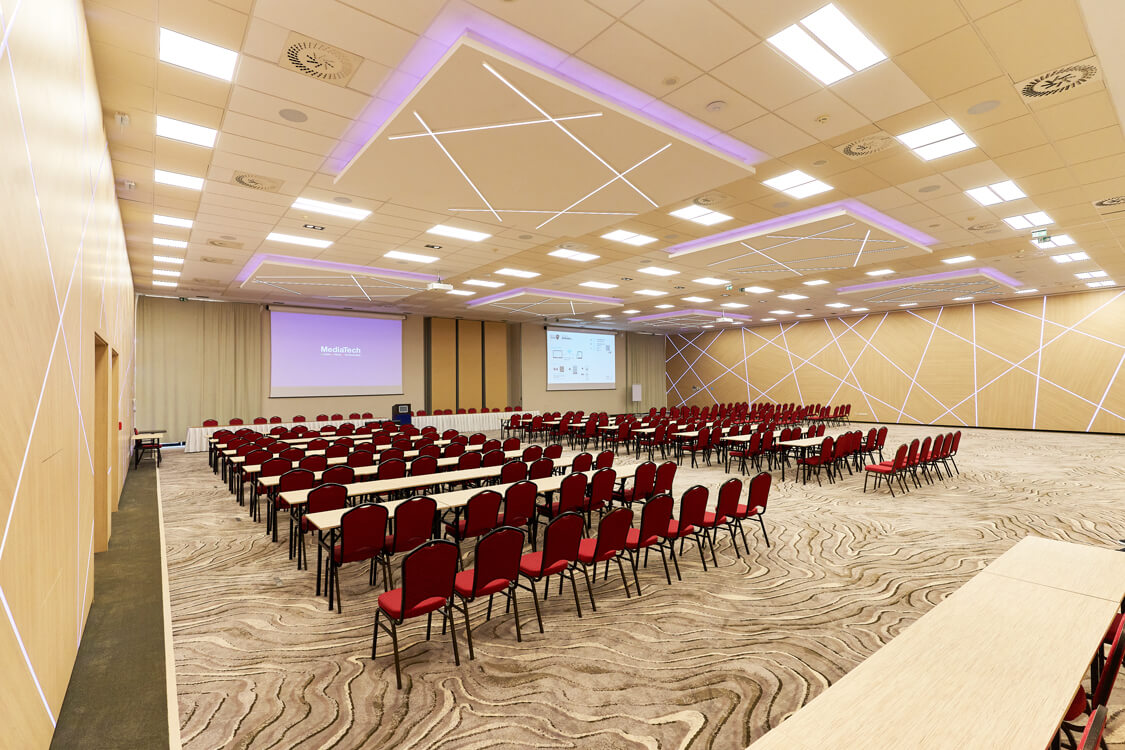
Hotel Senec Congress Centre is an example of why it makes sense to involve an AV supplier already in the planning phase. MediaTech entered the project while the spaces were still in project documentation. This allowed cabling, distribution routes and technology locations to be built directly into the construction, without additional interventions after final approval.
The congress hall with a capacity of up to 650 guests and smaller presentation rooms were designed as a multifunctional space for conferences, presentations, banquets, cultural and corporate events. The brief was clear. The system must handle all these modes without rebuilds and must be controlled simply and intuitively.
MediaTech built the solution on Yamaha technologies for sound and processors, Audio-Technica microphone systems, Epson video projection, Equipson and AV Stumpfl presentation technologies, and Crestron central control. All technologies are integrated into one control system with fixed and portable touch panels that staff can operate without training.
This is an exact example of architecture that works in hotel AV. One control system, unified control across rooms and staff who do not need to learn a new procedure for every event.
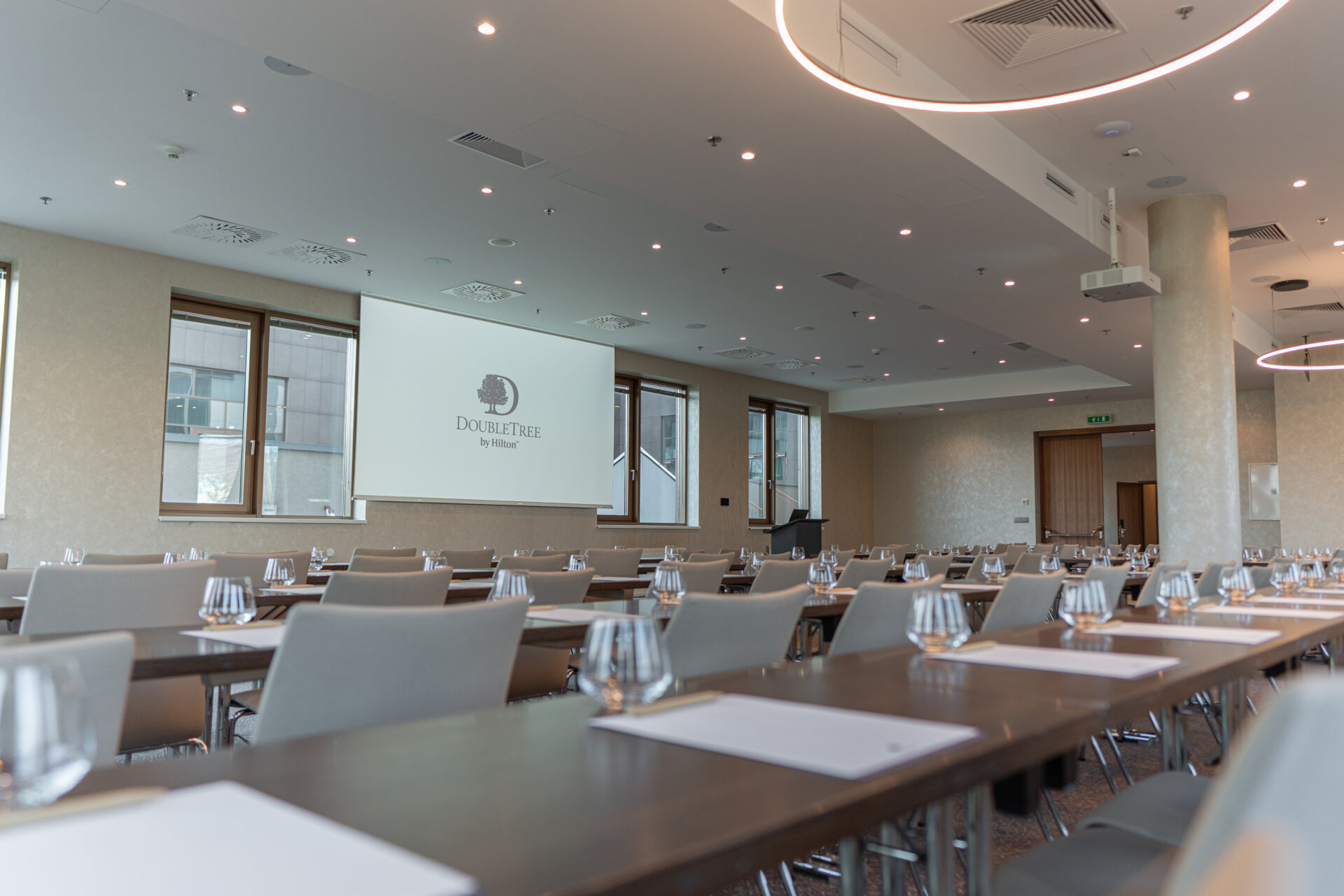
Conference spaces of Hilton DoubleTree Bratislava
The conference spaces of Hilton DoubleTree were modernized for corporate and congress clients, where every event has a different technical profile — from internal company meetings and press conferences to hybrid panel discussions.
The design integrated Shure wireless microphone systems, Crestron touch control, wireless presentation and specialized AudioPressBox audio outputs for press events. The key operational decision was that the entire system is controlled from one touch panel by hotel staff without technical assistance.
In a hotel environment, this is a critical requirement. A hotel cannot have an AV technician for every event. A receptionist or F&B manager must be able to start conference mode, panel discussion mode or press conference mode reliably. A system that requires a technician for every mode change will not be used properly in practice.
The common denominator of both projects is the same principle: centralized control through one platform, layered operation that untrained staff can handle, and early cooperation between the AV supplier, designer and architect.
Frequently asked questions
How much does a hotel sound system cost?
The cost of hotel AV varies depending on the number of zones, the type of architecture (island vs. centralized) and the complexity of integration. For smaller hotels with standard coverage, the basic investment starts from €10,000. For larger hotels with multi-zone control, system integration and conference facilities, it typically ranges from €30,000 to €100,000 and more. Centralized architecture has a 25–40% higher acquisition cost, but over a seven-year horizon the TCO comparison usually equals or exceeds that difference.
What is Dante and when does a hotel need it?
Dante is a network audio protocol where the audio signal is transmitted over an Ethernet network, similarly to data. Its main advantage is flexibility:
- adding zones without new cabling,
- integration with other systems and remote configuration.
A hotel needs Dante from roughly a four-star configuration and upward, or from the moment it has more than three separately controlled zones with different modes. In smaller hotels with simple operation, Dante is usually unnecessary.
Can we use Spotify or other streaming services?
No. Private streaming services such as Spotify, Apple Music and YouTube explicitly prohibit commercial use in their licence terms. A hotel using them is in breach twice:
- against authors, through SOZA/OZIS,
- and against the streaming provider.
Professional BGM services such as Soundtrack Business, Mood Media and similar include SOZA and OZIS licences in the monthly subscription price.
How many zones does a hotel actually need?
It depends on the size and concept of the hotel. A typical four-star hotel has 5–8 zones:
- reception/lobby,
- restaurant,
- breakfast room, if separate,
- wellness,
- conference rooms, each as a separate zone or grouped zones,
- event hall,
- corridors,
- and service spaces.
In resorts with multiple buildings, the number of zones can exceed 15. The decisive factor is not the number itself, but whether these zones are controlled independently or from a central interface.
How long is the life cycle of a hotel AV system?
Main components such as amplifiers, loudspeakers and control systems have a professional life cycle of 8–12 years. Microphones and some control panels are typically renewed sooner because their development is faster. Centralized control platforms such as Crestron or Biamp Tesira have the advantage that software can be updated continuously while the hardware remains valid for longer, because it does not age functionally, only in performance terms.
Do you also handle acoustic treatment or only sound systems?
We work at three levels of acoustics.
- For smaller spaces such as meeting rooms and small restaurants, we create an acoustic model internally using tools from acoustic material manufacturers.
- For commercial installations such as restaurants, lobbies and wellness areas, we simulate sound coverage in loudspeaker manufacturer tools such as Meyer Sound MAPP 3D or Yamaha NS-1.
- For complex spaces such as event halls and congress centres, we carry out an acoustic study through external partners. This is a separately paid service with reverberation time measurement, speech intelligibility (STI) measurement and simulation in EASE.
If you are considering modernizing hotel AV or designing new congress and conference facilities, the first step is an assessment of the current state and operating brief.
Order an AAVS audit for your hotel — an initial assessment of the hotel AV system with documentation of the current state and a proposal for consolidation or modernization.
MediaTech Central Europe, a.s. +421 220 999 700 | mediatech@mediatech.sk