Corporate Auditoriums and Hybrid Conferences: What Makes the System Work for Both Sides of the Transmission
In this article, you will learn how to design a system where the remote participant hears just as well as the audience in the room.
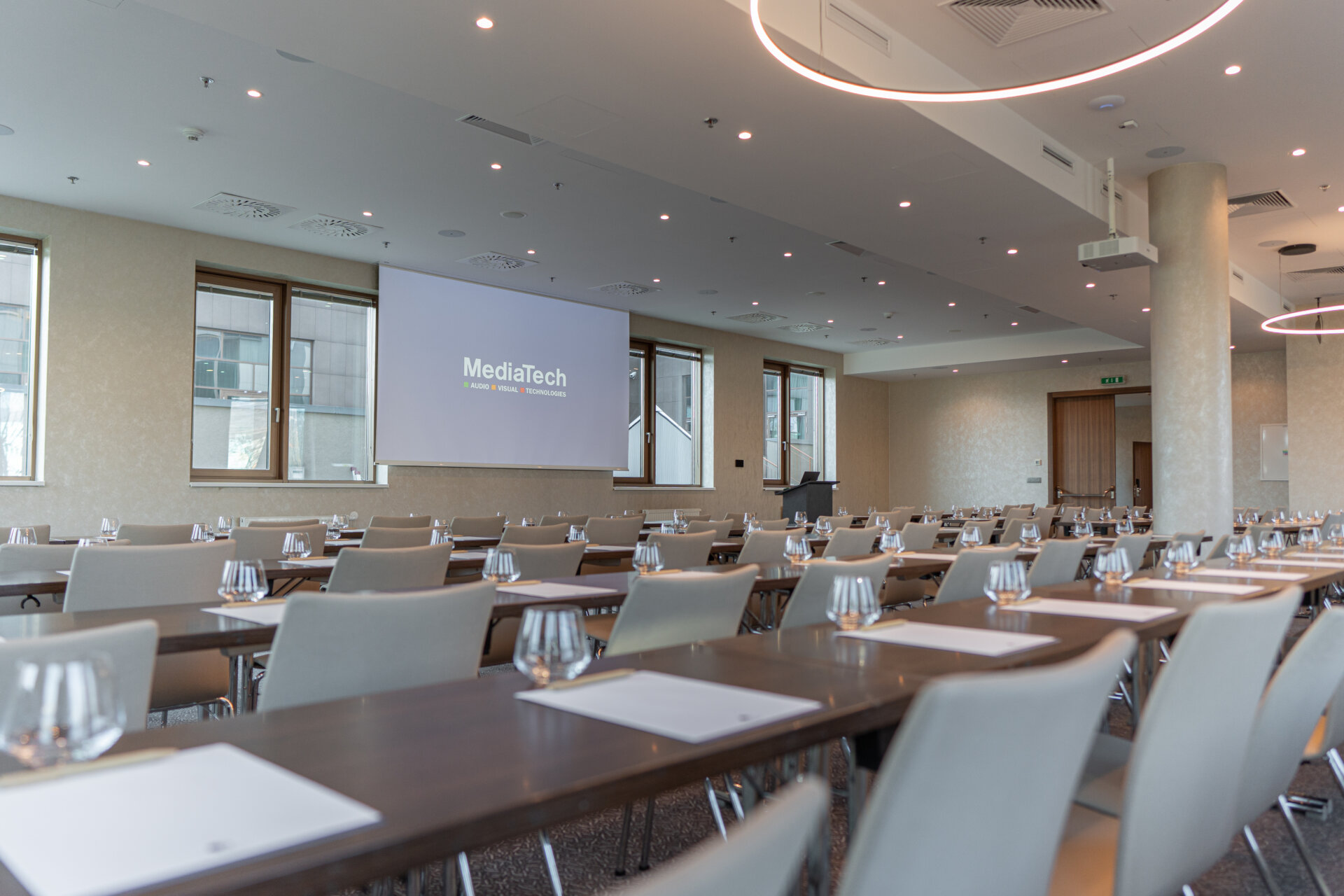
Quick summary
- Why speech intelligibility has replaced sound quality as the primary criterion
- Hybrid mode as the primary design framework
- What a line array does in an auditorium and when it becomes over-engineering
- Microphones and beamforming: where most mistakes happen
- Hall acoustics as the foundation, not decoration
- What is usually missing from a brief for an auditorium or congress hall
- How to recognize a supplier who understands hybrid auditoriums
- Three projects that illustrate the principles in practice
An auditorium or congress hall is rarely built today as a purely physical space. It is always also a transmission point. What is said in the room is often broadcast to connected participants, stored as a recording or transcribed for documentation. Sound in an auditorium is therefore not primarily only for the audience in the room. It is also for the audience that cannot see the room.
This changes what “good sound in an auditorium” actually means. In a purely physical setup, it used to be enough for the back row to hear the speaker. In hybrid mode, the participant on the other side of a Teams or Zoom call must also hear clearly, and their voice must be heard by the entire room as naturally as if they were physically present. These two requirements cannot be achieved independently.
As a result, designing a system for a corporate auditorium is no longer about choosing equipment. It has become the design of a communication architecture, where audio is only one of several layers.
Why speech intelligibility has replaced sound quality as the primary criterion
In corporate auditorium and hotel congress hall projects from the 1990s, the system was designed exclusively for the physically present audience. Today, the content has not changed as much as the transmission mode has. What is new is that it must be transmitted both ways: into the hall and from the hall to the connected participant. This shifts the main criterion.
Speech intelligibility has become the primary criterion. It is measured using STI (Speech Transmission Index), which expresses how well speech is transmitted through the space and system to the listener.
Values of 0.60–0.75 are considered good, 0.75 and above excellent, and below 0.45 speech becomes difficult to understand even for native speakers. For non-native speakers and hybrid participants, the threshold moves even higher, because listening to a remote voice through Teams or Zoom introduces its own degradation, which must be added to the acoustics of the room.
This has a practical consequence for the project brief. A specification such as “high-quality sound system” is not sufficient because it does not define what the system is supposed to achieve. A target STI value at different room occupancy levels is a measurable parameter that the supplier either guarantees or does not. Without it, project quality is judged subjectively only after completion.
Sound in an auditorium is therefore not primarily only for the audience in the room. It is also for the audience that cannot see the room.
Hybrid mode as the primary design framework
A hybrid meeting is not simply a hall with a video call added to it. It consists of two audiences with different acoustic conditions that must understand each other equally well.
- The audience in the hall hears the speaker through the room sound system.
- The connected participant hears the speaker through a network transmission and their own headphones or loudspeakers.
Speech from the connected participant travels in the opposite direction.
- From the microphone, through the network channel, into the hall’s reproduction system. For the whole chain to work, four system layers must be designed as one integrated whole, not as four separate deliveries.
Speech from the hall to the remote side
The microphones must cover the entire hall. In lecture mode, a speaker microphone and several wireless microphones for Q&A may be enough. In a panel discussion, every panelist must be covered separately. This is often a combination of boundary microphones or lavalier microphones. In an open discussion with the audience, audience coverage is added either through ceiling beamforming microphones or wireless handheld microphones passed through the audience.
Speech from the remote side into the hall
The voice of the connected participant must pass through the hall sound system without echo, feedback or delay that would make the remote speaker finish talking before the hall hears them. This is where the following are handled:
- AEC (Acoustic Echo Cancellation)
- Gain staging (correct gain setting at every point of the signal chain).
Without functional AEC, the remote participant hears their own voice with a one-second delay, making conversation unusable. Without correct gain staging, there is either noise in the hall or nothing can be heard from the hall.
Image and contextual presence
A remote participant is not just a voice. They must also be visible on the hall display at a sufficient size. Conversely, the camera in the hall must track the current speaker and transmit an image that gives the connected participant an equal sense of presence.
Without this, hybrid mode degrades into an asymmetrical transmission where the hall is the active participant and the remote attendee is merely an observer.
Control as a single point
All four layers must be controlled from one place. An operator at the control desk or an automated system switches between lecture mode, panel discussion mode and external speaker presentation mode. If every element of the system has its own control and its own settings, switching modes takes five minutes and creates five potential errors. If the system is integrated through a control protocol such as Crestron, Q-SYS or Extron, switching becomes one button and every layer adapts at the same time.
Without integrating these four layers, a hybrid meeting becomes an exercise in tolerance, and the audience perceives it as “technical problems”. In reality, these are not technical problems, but missing architecture.
What a line array does in an auditorium and when it becomes over-engineering
For a medium-sized or large auditorium with 200 to 1000 seats, a line array is usually the best solution for even sound field coverage and achieving a high STI value throughout the full depth of the space. A vertically arranged loudspeaker system creates a coherent wave that maintains intelligibility even in the back rows while not overpowering the front rows. When aimed correctly, the audience in the first and last rows hears the speaker at a similar level.
In smaller spaces, the logic changes
A line array in a standard meeting room or small conference room with up to 80 seats is over-engineering. A distributed setup of smaller loudspeakers covers the space with the same uniformity and at a lower cost. It is also easier to install and integrates better into the interior.
The borderline range is 100 to 200 seats. Here it depends on the geometry of the room, ceiling height and type of production. A hall with a high ceiling and deeper layout may benefit from a line array even at lower capacity. A compact hall with standard ceiling height probably will not.
This decision cannot be made without coverage simulation in a manufacturer tool, such as MAPP 3D for Meyer Sound or NS-1 for Yamaha. Estimating from a floor plan leads to poor results in this size category in two thirds of cases.
The decisive criterion is not the brand or the number of loudspeakers. It is coverage uniformity and the target STI value at different occupancy levels.
Which technology belongs in each room size is explained in the AV technology configuration guide.
Microphones and beamforming: where most mistakes happen
In a hybrid auditorium, microphones are more often the reason a meeting fails than loudspeakers. Loudspeaker issues become obvious during the first test. Microphone problems appear only during real use, for example when half of the questions disappear during a Q&A session, or when the remote participant becomes only a spectator during a panel discussion. Microphone shortcomings are simply not visible during project handover.
Microphone architecture in a corporate auditorium or congress hall typically has four variants.
Ceiling beamforming microphones
These are array microphones installed in the ceiling structure that automatically track the active speaker in the room. They are suitable for conference rooms and smaller auditoriums with flexible layouts.
Beamforming focuses directionally on the sound source and suppresses surrounding noise, which improves gain before feedback and intelligibility for the remote participant. Without proper control and calibration for the specific space, beamforming microphones do not work properly. It is not enough to simply mount them in the ceiling.
Table microphones
These are suitable for meeting rooms with a fixed layout and panel tables. Each participant has their own microphone within reach, which provides the highest speech quality for hybrid transmission. The disadvantage is visibility on the table and the number of cables for larger panels.
Wireless handheld and lavalier microphones
For the presenter, panelists away from the table and questions from the audience, these are a standard part of every auditorium. In larger spaces, however, frequency management is required, and in environments with multiple wireless systems such as microphones, in-ear monitors and simultaneous interpretation, frequency planning becomes a separate technical issue.
Hybrid setups
A combination of ceiling and wireless microphones covers all modes. In a professionally designed auditorium, this is standard, not an upgrade.
The decisive criterion is therefore coverage of all modes that the hall actually hosts and the ability to switch between them.

Hall acoustics as the foundation, not decoration
The loudspeaker and microphone architecture is designed on the assumption that the room itself has suitable acoustic properties. If it does not, no loudspeaker system or beamforming microphone will save it. Speech in an auditorium with excessive reverberation is unintelligible even if the calculated STI is 0.75. The final intelligibility after installation drops because the sound system simulation does not account for the real acoustic behaviour of the hall.
The target reverberation time for a congress hall or auditorium is usually 0.8 to 1.2 seconds, depending on size, occupancy and content.
- A hall above 1.5 seconds starts to become unusable for spoken word without acoustic treatment.
- A hall below 0.6 seconds is acoustically “dead” and loses naturalness for both the speaker and the audience.
For this type of project, a full acoustic study with reverberation time measurement, speech intelligibility measurement and EASE simulation is carried out by an external acoustic partner. MediaTech integrates this study with the design of the sound system, microphones and control.
For a corporate auditorium or congress hall, this step is not optional. It is the foundation on which everything else is built.
Which acoustic and spatial details should be resolved before the design stage are explained in the article on seven hidden details before designing video conferencing.
What is usually missing from a brief for an auditorium or congress hall
In Slovak and Czech AV project briefs, the budget, schedule and general requirement for “high-quality sound” are typically specified.
What is often missing are the following three points, whose presence determines whether the system behaves as expected after installation:
1. Target STI value at different room occupancy levels
A hall at 30% occupancy and a hall at 90% occupancy have different acoustics. Human bodies act as absorbers, changing reverberation and the speech-to-noise ratio.
A brief that specifies “STI ≥ 0.70 at 80% occupancy and ≥ 0.65 at 30% occupancy” gives the supplier a measurable target. Without this parameter, the offer delivers what is in the catalogue, not what the hall actually needs.
2. Specification of the hybrid mode
Which video conferencing system should the hall support: Microsoft Teams Rooms, Zoom Rooms, a custom solution through Crestron or Q-SYS, or a flexible hybrid mode as required.
What is the typical scenario?
- One speaker with several remote participants,
- a panel discussion with remote guests,
- or a workshop with active exchange between the hall and connected participants.
“How many remote participants must the system support while maintaining speech quality?” is a critical criterion without which a hybrid event will reveal that the project was underestimated.
3. Service level agreement after delivery
Who fixes failures, within how many hours, who has access to the control system, who trains the operator and how often preventive checks are performed.
An AV system in an auditorium or congress hall has a service life of 8 to 12 years. Without an SLA, service and support are handled ad hoc, which in a complex hybrid system means that the hall stops working before the equipment reaches the end of its life.
What a complete brief should contain is explained in the article on the contents of an AV project. How a service level agreement differs from a standard service contract is explained in the article on proactive SLA monitoring.
How to recognize a supplier who understands hybrid auditoriums
When choosing a supplier for a corporate auditorium or congress hall, several questions work as a diagnostic test:
1. What tool do you use for coverage and STI simulation?
Without coverage simulation, the design is only an estimate based on the floor plan. For smaller rooms, this may be enough, but from halls with 100 seats upward, it is not. Standard tools for coverage simulation include MAPP 3D, NS-1 and EASE. If the supplier uses none of them, the loudspeaker choice is being made according to the catalogue, not according to the room.
2. How do you design integration with our video conferencing system?
This question quickly reveals whether the supplier has real hybrid experience. A concrete answer sounds like “Microsoft Teams Rooms via a Crestron Flex panel with integration of ceiling beamforming microphones and an AEC processor” or something similarly specific. A vague answer such as “We will put Teams in there” means the supplier does not have professional hybrid installations in their portfolio.
3. What is your process for AEC and gain staging in hybrid meetings?
This is a technical question, but a crucial one. AEC and gain staging are two of the most common causes of hybrid event failure. The remote participant hears themselves, or nothing can be heard from the hall. A supplier who answers “we will set it during installation” underestimates the process. A good design includes calibration for the specific space, test scenarios before handover and tuning during the first weeks of operation.
4. What support do you provide after delivery?
Operator training, repair SLA, remote access for diagnostics and preventive inspections. An auditorium AV system with an 8 to 12-year service life needs support throughout its entire lifetime, not only during warranty.
How to incorporate these questions into a tender scoring matrix is explained in the article on evaluating AV integrators in a tender.
Three projects that illustrate the principles in practice
The principles of hybrid mode, microphone architecture and integrated control are best demonstrated in projects where all four system layers meet in real operation.
Auditorium of the Slovak Medical University in Banská Bystrica
The multifunctional complex of the Slovak Medical University in Banská Bystrica is an example of an auditorium that considered transmission mode as a primary function from the very beginning. The auditorium is used for standard academic events such as lectures, graduations and ceremonial academic acts, as well as technically demanding formats including live transmissions of surgical operations from clinics in Slovakia and across Europe. Telepresence is a normal operating mode, not an exception.
From a design perspective, this meant that the system had to support two-way transmission with high speech intelligibility, integration with interpreter booths, simultaneous interpretation and control that the operator can handle without training before every new event.
After the project was completed, the university bursar stated that the auditorium meets the parameters of top-level acoustics and high-quality information technologies. This type of feedback matters because it comes from an environment where the system is used intensively and in different modes.
Conference facilities of the Hilton DoubleTree Bratislava hotel
The conference rooms at the Hilton DoubleTree hotel were modernized for corporate and congress clients, where every event can have a different technical profile, from internal company meetings and press conferences to hybrid panel discussions.
The design integrated Shure wireless microphone systems, Crestron touch control, wireless presentation and specialized AudioPressBox audio outputs for press events. Control from a single touch panel allows hotel staff to switch between modes without technical assistance, which is a critical requirement in a hotel environment.
Hotel Sitno Congress Centre
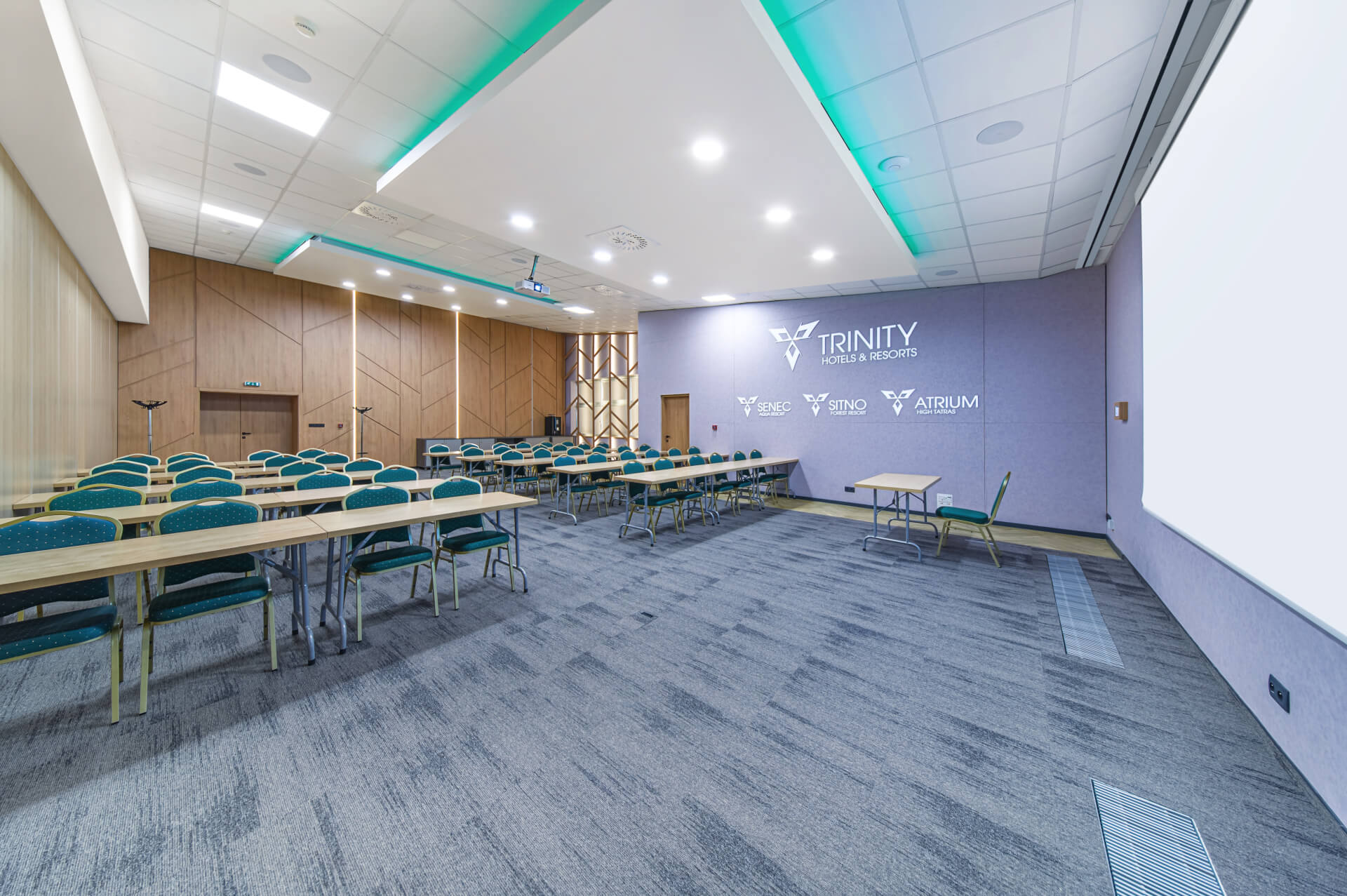
Hotel Sitno (Trinity Hotels & Resort) is an example of a multifunctional congress space where one hall hosts a conference, panel discussion, banquet and cultural event during the same week.
The design had to support all modes without rebuilding the room. Early cooperation with the project designer was the key element. Cabling and preparation work were carried out in parallel with construction, avoiding later interventions into the finished interior. Integrating AV technology into the interior design was just as important in this project as the technical parameters, because a hotel space is also sold through atmosphere.
The common denominator of all three projects is integrated control, microphone architecture adapted to the typical scenario and early cooperation between AV design, acoustics and interior design.

Frequently asked questions
What STI values should a corporate auditorium or congress hall achieve?
For a congress hall and corporate auditorium, the target STI value is 0.70 and above. Values of 0.60–0.75 are considered good, while 0.75 and above are excellent.
For hybrid mode with remote participants via Teams or Zoom, the threshold moves even higher, because network transmission adds its own degradation, which is added to the acoustics of the room.
What reverberation time is suitable for a congress hall?
The target reverberation time for a congress hall or auditorium is 0.8 to 1.2 seconds, depending on size, occupancy and content. A hall above 1.5 seconds starts to become unusable for spoken word without acoustic treatment. A hall below 0.6 seconds is acoustically too damped and loses naturalness for both the speaker and the audience.
What is AEC and why is it important in hybrid meetings?
AEC (Acoustic Echo Cancellation) is a technology that prevents the remote participant from hearing their own voice returned from the hall through the microphones.
Without functional AEC, the participant hears themselves with a delay, which makes conversation unpleasant. AEC must be set up for the specific space and cannot simply be “switched on” — it requires calibration and testing before project handover.
What is the best microphone for hybrid conferences in an auditorium?
It depends on the layout and the type of event.
For conference rooms and smaller auditoriums with flexible layouts, ceiling beamforming microphones work best because they automatically track the active speaker.
For meeting rooms with fixed layouts, boundary microphones on tables are also suitable.
For presenters and audience questions, wireless handheld and lavalier microphones are required. In a professional hybrid setup, all three types are combined.
When does it make sense to use a line array and when is a distributed system better?
A line array is suitable for medium-sized and large auditoriums with 200 to 1000 seats, where it provides even coverage and a high STI value across the full length of the space.
In smaller spaces up to 80 seats, a line array is usually over-engineering. A distributed setup of smaller loudspeakers covers the space with the same uniformity and at a lower cost.
The borderline range of 100 to 200 seats depends on room geometry and requires coverage simulation in a manufacturer tool such as MAPP 3D or NS-1.
How much does an AV system for a congress hall cost?
The cost depends on the size of the hall, the technical complexity of the hybrid mode and integration with other building systems. An auditorium with a full hybrid setup, line array sound system, beamforming microphones and integrated control typically costs in the tens to hundreds of thousands of euros. A solution included in the project documentation before construction is completed is significantly cheaper than a later retrofit installation.
If you are deciding on the design of a new auditorium, modernizing a congress hall or adding hybrid mode to an existing space, the first step is an assessment of the current condition and operational brief.
Book an AAVS audit for your auditorium or congress hall
MediaTech Central Europe, a.s. +421 220 999 700 | mediatech@mediatech.sk