Sound Systems for Recording, Radio and Podcast Studios
Reading time: 9 minutes
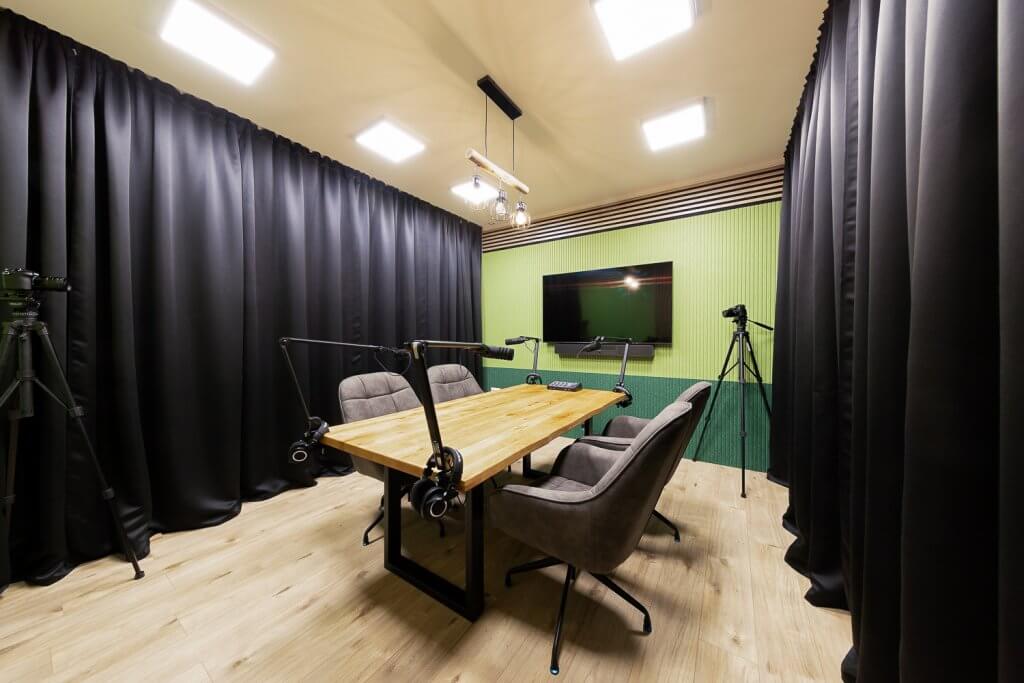
In a studio, the microphone is the listener. Everything the room adds to the sound remains permanently in the recording.
A studio is the reverse of a conventional sound reinforcement project. In an auditorium, sound is projected into the room. In a studio, the influence of the room is reduced to a level where it no longer interferes with the recording. The result therefore depends on the acoustics of the room and on what enters it from outside. This is why the room is addressed first and the technology comes afterwards.
Quick overview
- Why a studio is the reverse of an auditorium
- Three types of studios and how their project briefs differ
- What construction solves and what technology solves
- Six things to include in a studio project brief
- When treating an existing room is enough
- How to decide between treating a room and building a studio
- Frequently asked questions
Why a studio is the reverse of an auditorium
In an auditorium sound system, the objective is to distribute sound evenly across the audience area. The room is an obstacle that needs to be taken into account, and the result is evaluated at the listener’s position.
Room acoustics are determined by the materials and surfaces that absorb or reflect sound, and their influence becomes part of the recording.
There is also a second layer that is usually irrelevant in a conventional office. Ventilation, activity behind the wall, traffic outside the building and a corridor behind the door all create background noise that nobody notices during an ordinary company meeting. In a recording, you can hear it.
A studio therefore belongs to the category of spaces where the room influences the result more than the technology installed in it. Our article about an acoustically challenging space explains what defines this category and how the design process changes.
Three types of studios and how their project briefs differ
The word studio covers three different types of projects. If the brief does not distinguish between them, you will receive proposals that cannot be compared fairly.
Recording and music studio. This type of studio is used for music recording, often with several instruments being recorded at the same time. The room must handle a wide dynamic range as well as low frequencies. Low frequencies have long wavelengths, which means they become more problematic in small rooms than high frequencies and are more difficult to control. The recording room is separated from the control room, which is a second room where the sound engineer works and needs to hear an accurate representation of the recording. MediaTech projects in this category include Tonstudio Rajchman, Creative Music House and Beyond Music Studio.
Dynamic range is the difference between the quietest and loudest sound that appears in a recording. A room handles it correctly when quiet passages are not masked by background noise and louder passages do not excite excessive reverberation within the room itself.
Radio and television studio. This type of studio is used for live broadcasting or recording content for broadcast, so in addition to acoustics it requires operational reliability and communication between the studio and the control room. The space is usually smaller and dominated by speech. Poor acoustics therefore affect intelligibility directly. MediaTech projects in this category include Fun Rádio, Rádio Expres, Rádio Europa 2, RTVS Banská Bystrica, Televízia Markíza and Slovak Radio outside broadcast vehicles.
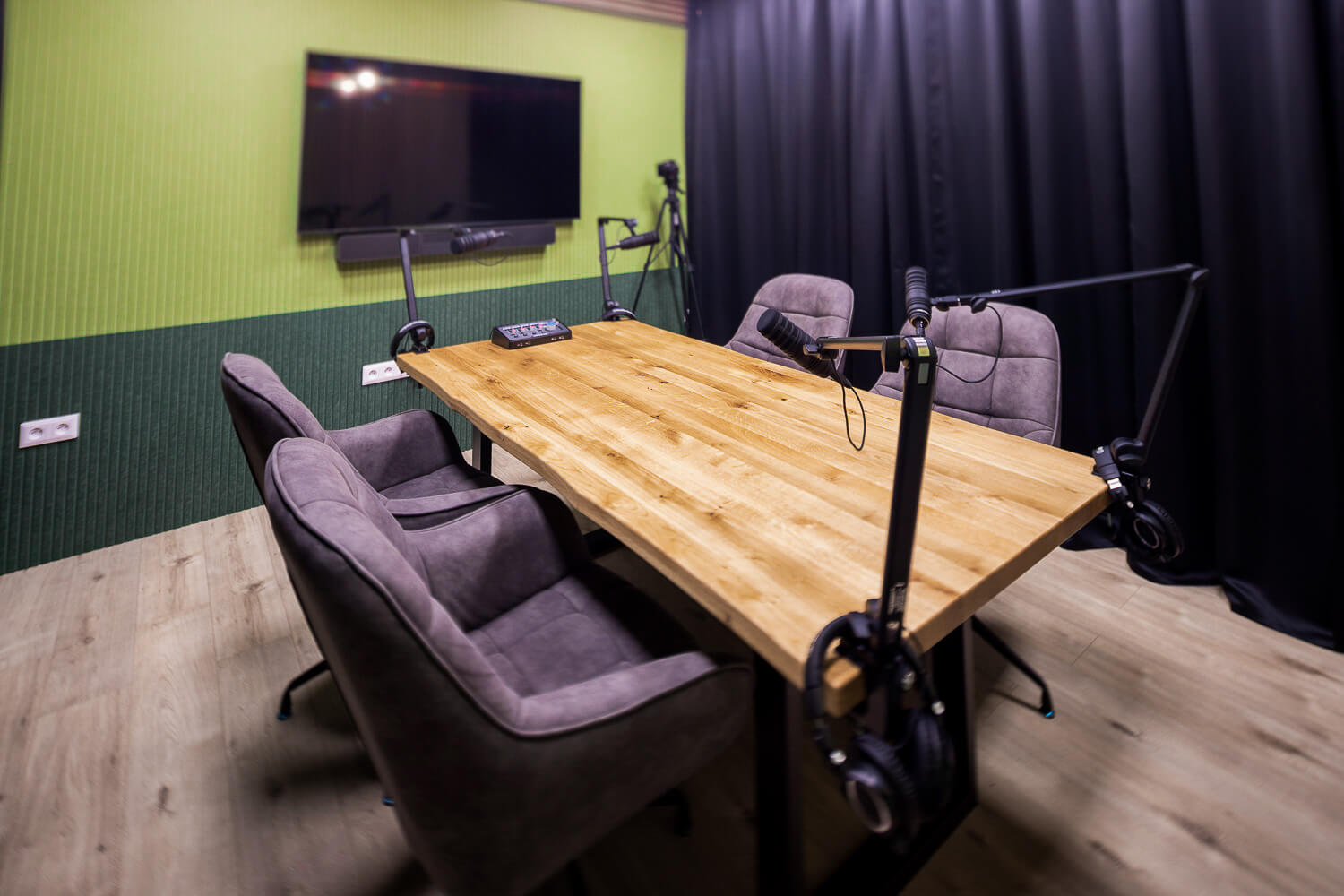
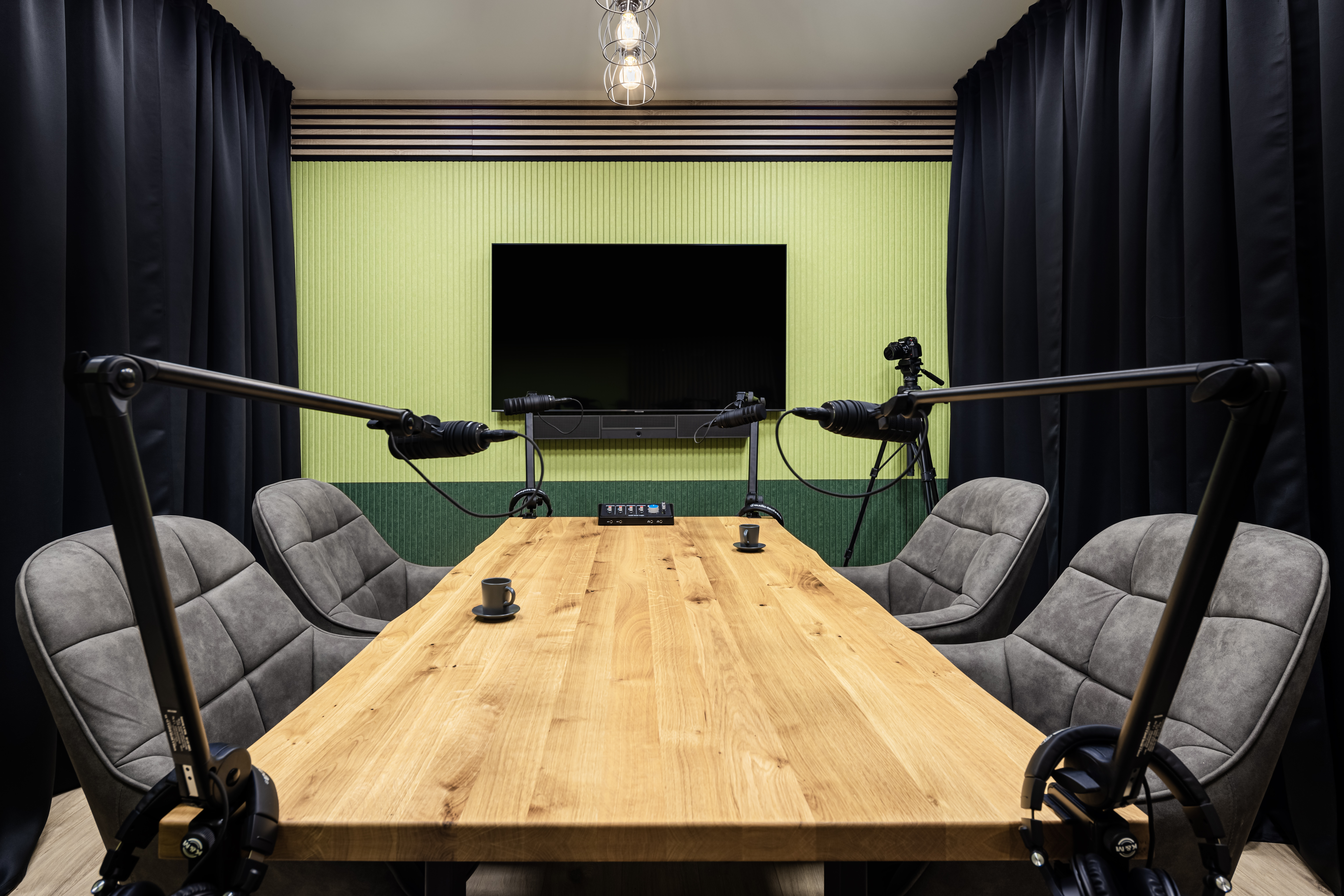
Corporate podcast studio. This is typically created within a company that regularly produces content such as podcasts, employee videos or customer webinars. It is usually a single room within an existing building and is operated by people without professional audio training. MediaTech delivered the Avocast podcast studio in this category. When the studio is created inside an existing room, the budget is usually operational rather than capital expenditure.
What construction solves and what technology solves
One proposal you receive may include construction work while another may not, even though both refer to the same room.
Construction and acoustic treatment address two things. The first is what enters the room from outside, which depends on the wall construction, doors, windows and ventilation routes. The second is how sound behaves inside the room, which depends on the balance between absorptive and reflective surfaces.
Technology deals with capture, signal processing, monitoring and communication between rooms. It can only work with what the space allows. A microphone cannot compensate for the acoustic characteristics of the room.
Monitoring is the reproduction system used to check the recording, meaning studio loudspeakers or headphones. The sound engineer hears the recording through them as it is being made. The purpose is to reveal the recording accurately, not to make it sound better than it really is.
At MediaTech, acoustic treatment is available as a standalone service and can be ordered without purchasing the technology. Acoustics also has its own reference category on the website, including projects for Televízia Markíza, RTVS Banská Bystrica and Rádio Europa 2.
Six things to include in a studio project brief
Your project brief should contain six things, and specific equipment models are not among them. A list of microphones and loudspeakers is an output of the design, not an input. If a supplier asks you for this list at the beginning, the equipment should instead be selected based on what you tell them about the room and the recording requirements.
- What will be recorded in the studio. Speech, music or both. What happens in the room determines the scope of the project. Floor area itself is not one of the decisive factors.
- How many people will be recorded at the same time. One presenter with two guests is a very different task from recording a band.
- Whether you will also record video. Video introduces surfaces that need to look good on camera while also avoiding unwanted sound reflections.
- Who will operate the studio. A professional sound engineer or a marketing employee who uses the room for one hour a week require very different operating workflows.
- What is behind the walls, above the ceiling and below the floor. A neighbouring business, lift shaft or ventilation plant room needs to be considered at the beginning of the project or it may become extremely difficult to address later.
- Whether the space is rented. This determines which construction interventions are possible at all.
When treating an existing room is enough
Not every corporate studio requires a construction project.
If the studio is primarily used for speech, only a small number of people are recorded at once, the room is located in a quieter part of the building and it will be operated by people without professional audio training, the solution is often acoustic treatment of the existing room. This means modifying its surfaces without changing the building structure and installing a system that can be operated without specialist training. Construction work is unnecessary and the budget remains operational expenditure.
The boundary is reached when music is recorded, when several people are recorded simultaneously or when the background noise is too high to be reduced by treating the room surfaces. Background noise is a critical parameter because internal surface treatment controls reflections, not noise entering from outside. It is expressed in decibels as dB(A). For a corporate podcast studio in an existing room, MediaTech targets background noise below 35 dB(A), while radio and music studios target below 30 dB(A). These are practical values that can realistically be achieved in a completed space rather than idealised theoretical figures. They are target values, not fixed thresholds that automatically determine whether construction work is necessary.
For a simple room, dedicated project documentation is not normally produced and manufacturer diagrams are used instead. For more complex projects where several technologies are interconnected, documentation is prepared and becomes a separately paid part of the project. In both cases, the design follows AVIXA standards. For acoustically complex spaces, Slovak standards STN EN ISO 3382, STN 73 0525 and STN 73 0527 may also apply. This is a different type of complexity from the complexity of the technology integration itself. Our article about what an AV project should contain explains what should be included in the documentation.
If you are unsure which category your project belongs to, that is exactly the question the supplier should answer before preparing a quotation. Our article on how to choose a sound system supplier explains what to look for.
How to decide between treating a room and building a studio
Both approaches can produce a functional result. They differ in what you pay for and what you receive.
Treating an existing room means accepting the space largely as it is and working with its surfaces and with the sound entering from outside. The budget is operational expenditure. The structure, doors, windows and ventilation routes are not modified. Surface treatment without structural intervention can normally be completed within six to eight weeks from the order date. This period also includes approval of the quotation, ordering, delivery and scheduling of the installation. The limitation is clear: background noise can only be reduced to a limited extent and recording music in such a room will involve compromises.
A construction solution, meaning building a studio, involves modifications to the structure, doors, windows and ventilation routes. It addresses what surface treatment cannot solve, particularly sound entering from outside. The budget is capital expenditure and implementation becomes part of the construction project. The decision must be made while the construction project is still being planned. In an existing finished building, it becomes a refurbishment project and the decision belongs to the planning stage of that refurbishment.
Operational expenditure is money used for normal business operations, generally managed by the department itself and typically approved by its manager. Capital expenditure is money allocated to assets and changes to the building. It is usually approved by company management and planned in advance together with other investments.
The boundary between the two approaches is defined by three questions. Are you recording music or speech? Do you own or rent the space? And is the background noise low enough that surface treatment will be sufficient? All three answers need to support the lighter approach. Any one of them can independently move the project towards the more complex construction solution, and each for a different reason. Music places greater demands on the room. Background noise remains because internal surface treatment cannot eliminate external noise. Renting determines whether modifications to the building structure are possible at all. This may require discussion with the landlord or may be a reason to consider a different room.
The actual price can only be determined from a proposal for the specific space. A smaller sound system project at MediaTech starts at around €3,000.
If you only need individual components rather than a complete project, MediaTech also sells them through the zvuk.sk online store where prices are public and can be compared. This includes acoustic materials, recording equipment and studio monitors.
Frequently asked questions
Why do studio proposals so often differ significantly? Usually because one includes modifications to the building and the other does not. A project brief that does not specify whether structural work is permitted will produce proposals that cannot be compared directly. The decisive inputs are what will be recorded and what is located behind the walls of the room.
Does a corporate podcast studio require a construction project? Usually not. A construction solution means modifications to the structure, doors, windows and ventilation routes. For speech, a small number of people and a room in a quieter part of the building, acoustic treatment of the existing room is often sufficient. Construction work becomes relevant when music is recorded, when more people are recorded simultaneously or when background noise is too high to be eliminated through surface treatment.
What needs to be established about the space before designing a studio? What is behind the walls, above the ceiling and below the floor. A neighbouring business, lift shaft or ventilation plant room can be addressed at the beginning of the project but becomes much harder to deal with once the studio is complete. You also need to know whether the space is rented because this determines the extent of possible construction work.
Does MediaTech provide acoustic treatment as well as technology? Acoustic treatment can be ordered separately without purchasing the technology. Acoustic treatment has its own reference category on the MediaTech website, including projects for Televízia Markíza, RTVS Banská Bystrica and Rádio Europa 2. For a studio, this means the room itself can be treated even if another supplier provides the recording equipment.
Can audio and video be recorded in the same room? Yes, but it introduces additional constraints. Surfaces need to look good on camera while also avoiding unwanted sound reflections, so materials need to be selected for both requirements at the same time. Lighting and its positioning also need to be considered. It is entirely achievable, but it needs to be included in the brief from the beginning rather than added after installation.
How much does a smaller MediaTech project cost? A smaller sound system project starts at around €3,000. This is an indicative figure rather than a price list. The exact amount can only be determined from a quotation for the actual space. The proposal depends on what will be recorded and what is located around the room, so it is normally preceded by a site survey. For remote locations, detailed photographs and a floor plan together with detailed communication about how the studio will be used can replace the site visit. Individual components without a complete project are sold through the zvuk.sk online store at publicly available prices.
When should you treat an existing room and when should you build a studio? Three things determine the answer: whether you are recording music or speech, whether the space is owned or rented, and the background-noise level. For speech in an owned, relatively quiet space, surface treatment is often sufficient and can normally be completed within six to eight weeks from ordering. Any one of the three factors can move the project towards a construction solution. The decision about construction work needs to be made while the building or refurbishment project is still being planned.
Next step
If you are planning a recording, radio or corporate podcast studio, its scope cannot be determined without understanding the actual room.
Send us the floor plan and photographs of the space and tell us what you want to produce there.