Restaurant Sound System and the Impact of Acoustics on Average Guest Spend
Reading time: 11 minutes

Quick summary
- How noise levels form in a restaurant
- The economics of the second drink
- Three acoustic problems that repeatedly appear in restaurants
- Acoustics in restaurant chains and hotel F&B
- What to do in a new project and what to do during renovation
- How to recognize a supplier who understands restaurants
- Frequently asked questions
A restaurant is one of the few commercial spaces where sound is not optimized for a listener, but for the way a group of people behaves at a table.
This is what separates the acoustic design of a restaurant from the acoustic design of a conference hall or an event space.
- In a hall, speech intelligibility for the audience is optimized.
- At an event, sound pressure for the event is optimized.
- In a restaurant, conversational comfort for people at tables is optimized, where every table has its own conversation and every guest also contributes to the acoustic situation of everyone else.
This affects how long a guest stays at the table. And that affects what they have time to order.
How noise levels form in a restaurant
When you speak to the person sitting across from you in a restaurant, you adjust your voice to the level needed for them to hear you. If the background noise in the room increases, you instinctively raise your voice. Every other table does the same. The resulting level does not rise linearly, but reactively, because everyone who speaks is responding to everyone else.
This mechanism has a name in acoustics. It is called the Lombard effect. A person automatically adjusts the loudness and articulation of speech depending on how much they need to cut through surrounding noise. At ambient levels below roughly 60 dB(A), people speak comfortably at around 55–60 dB.
When the level exceeds 70 dB(A), they switch to a raised voice above 70 dB. This means that every additional table joining the conversation pushes the total noise level higher.
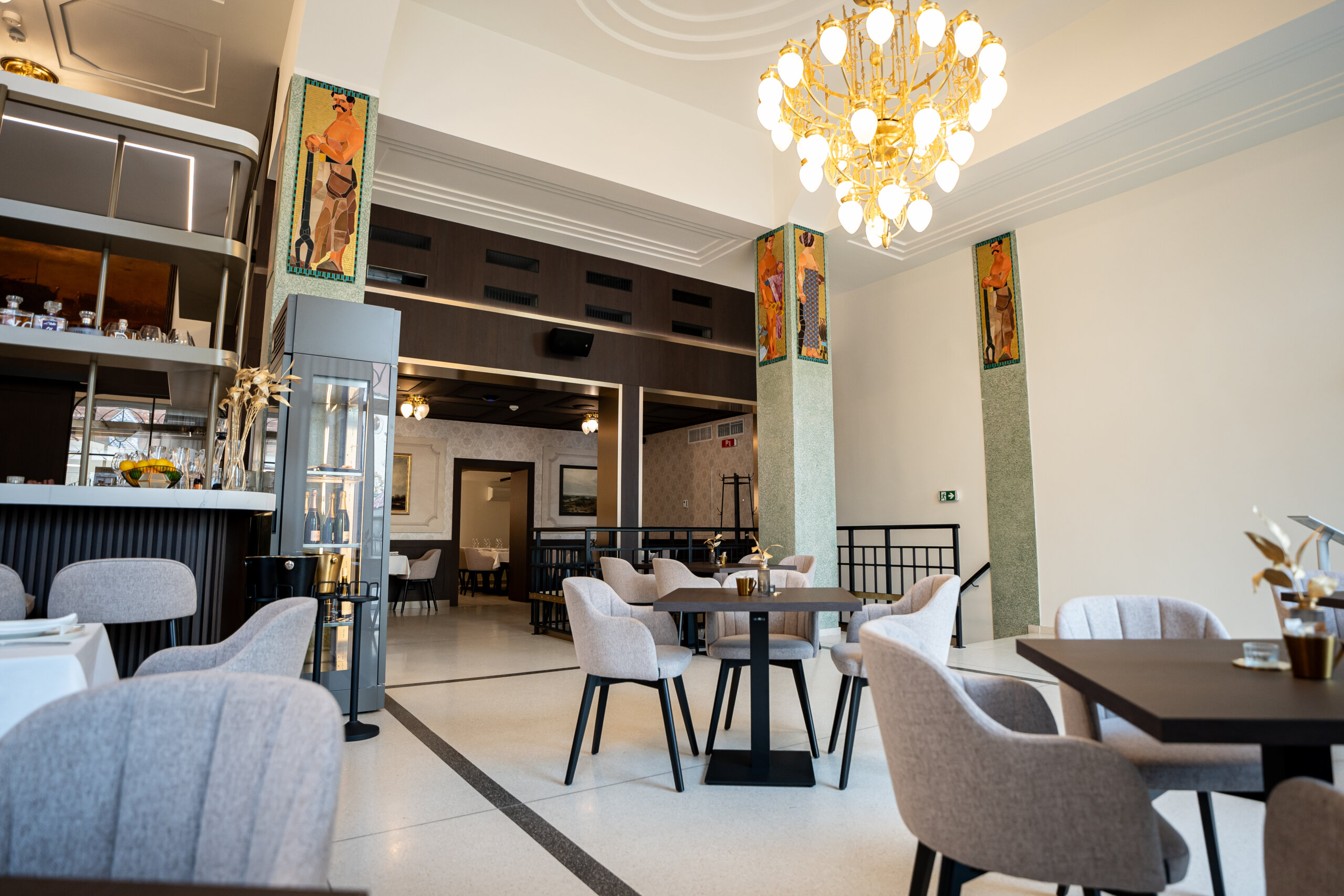
The second factor that determines how noise behaves in a space is reverberation. Hard surfaces reflect sound for longer until it decays. The longer the reverberation time, the less intelligible speech becomes and the faster Lombard escalation occurs. Modern restaurant design is not friendly to this combination. The industrial look that has become an aesthetic standard over the last ten to fifteen years is, acoustically speaking, a perfect model of what not to do.
The guest at the table will not name this mechanism. They will not say “the reverberation time is too long and Lombard escalation is exhausting me”. They will not even realize they feel tired, that conversation is taking effort, and that it is time to pay. They will simply do it.
The economics of the second drink
A restaurant earns money on two types of items.
- Main courses, which cover operations.
- Drinks, desserts and starters, which create margin. But guests order them only when they have time, appetite and comfort.
This means that margin-generating items are ordered in the second half of the stay, when the guest decides whether to remain seated.
The acoustic situation of the space directly affects that decision. A guest who can hear people at the table comfortably is more likely to order a second drink or dessert. A guest who has to speak louder and understand with more effort will finish their drink, pay and leave.
In an operation serving 60–80 guests per day, this can mean several hundred euros.
This opens a question that is almost never asked during renovations. When deciding on sound systems and acoustics, people almost always ask how much the system costs, but almost never how much the absence of guests costs.
This insight gives you a criterion for measuring the seriousness of a supplier. If nobody asks you about average dwell time, guest type and the daily operating profile when preparing an offer for a sound system or acoustic treatment, it is a delivery of equipment, not a system design.
Three acoustic problems that repeatedly appear in restaurants
Acoustic problems in restaurants fall into three categories. Once you identify which category your problem belongs to, you will know what can be done about it.
Long reverberation time. Hard surfaces such as concrete, glass, plaster or wooden ceilings reflect sound for longer before it decays. In an acoustically comfortable restaurant, reverberation time is around 0.6 seconds. In industrial-style spaces, it often exceeds one second. This is solved with absorption panels, suspended acoustic elements, upholstery and textiles.
A point source of noise. An open kitchen, a bar with a coffee machine, air conditioning or an entrance with frequent opening. Tables near the source become unusable. This is solved either by damping the source or by acoustic separation.
Uneven sound distribution. Two loudspeakers in a corner mean one guest sits in a loud zone while another barely hears the music. This problem is solved by using more smaller loudspeakers distributed so that each table receives a similar sound level.
Acoustics in restaurant chains and hotel F&B
In a single restaurant, acoustics are a question of one space. In a chain or hotel F&B, they become a portfolio question. Different project, different decision criteria.
Standardization across operations
A chain operating ten or more units needs every location to sound similar, be controlled in the same way and be serviced in the same way. This means a unified loudspeaker specification, a unified BGM system and a unified way of setting volume on site.
Without a standard, every new location becomes a reinvention of the wheel, every loudspeaker replacement becomes a separate decision, and every new manager develops a different way of working with the system.
Integration with other hotel systems
A hotel restaurant rarely stands alone. It usually shares part of the sound system with the lobby or reception, the BGM system with the wellness or pool area, and control with the hotel’s central AV system.
For a new restaurant in a hotel, the decision is whether to extend the existing infrastructure, typically through network audio protocols such as Dante, or build a separate system.
- The first path is cheaper to operate and more consistent to control.
- The second path is cheaper to install, but it creates an island that is harder to manage.
Installation and service during operation
Neither a chain nor a hotel can afford to close an operation for a week because of acoustic treatment. The design must account for installation either during a night window, in phases by zone, or during a season with lower occupancy. The service regime after installation follows the same logic. Replacing a loudspeaker during lunch is not the same intervention as replacing it in a closed venue. The supplier should have both the schedule and the SLA for service during operation resolved.
These three criteria do not matter much in a single restaurant, but in a portfolio they are decisive.
- A standardized specification that the chain can adopt and repeat.
- Openness to integration with existing hotel infrastructure, including network audio protocols.
And an operating regime that assumes the venue will not close.

What to do in a new project and what to do during renovation
Restaurant acoustics are handled in two completely different starting situations. Either the project is still being prepared and decisions about materials, geometry and layout are still open. Or the operation already exists and has a specific problem. These two situations have different solutions, different costs and different levels of freedom.
New project
In a new project, acoustics are solved in the project documentation, not after final approval. Decisions about floor and wall materials, ceiling height, table and bar layout, and kitchen placement all affect the result before the first loudspeaker is installed.
A cost included in the project usually does not appear as a separate invoice: carpet instead of tiles in a specific zone, an acoustic ceiling instead of plasterboard, or table placement designed with reflection surfaces in mind. All of this is done from the same budget as the standard construction work, only with a different brief.
Additional acoustic treatment of an existing operation costs significantly more. Materials must be dismantled or covered, panels and absorption elements added to a finished interior, and the table layout is already fixed. The price difference between “solve it in the project” and “solve it after final approval” is not marginal.
It follows that the cheapest moment to address acoustics is the phase when nobody is talking about acoustics yet.
Existing operation
If the operation already exists and has an acoustic problem, the first step is an assessment of the current state.
In smaller spaces such as cafés or small restaurants, an acoustic model is created. Physical dimensions and wall, floor and ceiling materials are entered into a simulation tool, which generates a graph of the acoustic behaviour before and after applying acoustic elements. This model is provided by the manufacturer of the acoustic panels, which are then specified and installed according to the result.
In larger and more complex spaces, an acoustic model is not enough. In these cases, a full acoustic study is carried out, including measurement of reverberation time, speech intelligibility (STI) and simulation in specialized software such as EASE. This study is carried out by an external acoustic partner, while MediaTech integrates it with the sound system and control design. This is a separately paid service and makes sense for projects where the investment into acoustics and sound systems goes beyond a few panels.
Sound coverage is simulated separately in manufacturer tools. For Meyer Sound, this is done in MAPP 3D; for Yamaha, in NS-1. The goal is for every table to receive a similar sound level and for the distribution to match the room layout before installation.
Many problems can also be solved without major reconstruction. Adding absorption panels in the right zones, redistributing the sound system, changing DSP settings, or replacing two loudspeakers with four smaller ones will often solve a large part of the problem. Full interior reconstruction is reserved for situations where materials and space geometry are such strong limits that small interventions are not enough.
How to recognize a supplier who understands restaurants
When choosing a supplier for a restaurant sound system and acoustic treatment, several questions work as a diagnostic test. The answer shows whether this is a system design based on how the space is actually used, or just an equipment delivery based on budget.
1. What tool do you use to simulate coverage and the acoustic behaviour of the space?
A sound system design without coverage simulation means the loudspeaker distribution is estimated. In a small café, that may be enough. In a restaurant with an irregular layout, multiple zones or an open space, estimation is unreliable. In acoustic treatment, the equivalent is an acoustic model — a tool that shows what changes after panels are installed.
2. Who handles the acoustic side if the project requires it?
Acoustics and sound reinforcement are two different disciplines. Sound reinforcement deals with how sound is produced and distributed. Acoustics deals with how the space behaves after the sound is created. More complex projects require both, and most AV integrators do not have an acoustician in-house. They either cooperate with an external partner, or they simply do not handle the acoustic side. This question reveals which option applies.
3. How will the system be controlled during operation?
A restaurant has different parts of the day with different requirements. A quiet lunch, a more energetic dinner, a weekend atmosphere. Manual control through a physical potentiometer at the bar means it will never be changed. A professional BGM system with preset profiles and automatic switching according to time of day means the system behaves as designed, without staff intervention. The option a supplier proposes shows whether they are thinking about the day after installation.
4. How have you solved the music licence?
A supplier who answers “just play Spotify” does not understand the licensing regime that applies to hospitality operations. Professional BGM solutions include SOZA and OZIS licences directly in the price, so the operator does not need to deal with anything and has documentation in case of inspection. Private streaming does not provide this protection.
What an AAVS audit for a restaurant includes
An AAVS audit is the initial step MediaTech carries out before designing any restaurant sound system or acoustic treatment project. The goal is to bring the current state of the space and the operating brief into one document, which then determines what should be done and to what extent.
In practice, it includes a site inspection with documentation of dimensions, materials and current technical equipment.
It also includes a conversation with the operator about how the space is used throughout the day, when it is full, where the problem zones are, and what type of guest is expected.
For smaller spaces, an acoustic model is then prepared. For larger or more complex ones, a full acoustic study with an external partner is recommended. The output is a document with proposed interventions ranked by cost-impact ratio.
The AAVS audit is a separately paid service and does not oblige the client to order implementation from MediaTech. In practice, the audit may recommend a solution that MediaTech does not even supply, such as replacing the floor or changing the table layout before any technical intervention.

Frequently asked questions
What is the ideal noise level in a restaurant?
For a restaurant focused on calm conversation, the ambient noise level is around 55–65 dB(A). For more energetic venues, bars and bistro concepts, an acceptable range is 65–75 dB(A). Above 75 dB(A), guests automatically raise their voices, which triggers Lombard escalation and demonstrably shortens the stay. The specific target depends on the venue concept and guest type.
How much does restaurant acoustic treatment cost?
The cost depends on the size of the space, the problem and whether it is a new project or an additional treatment. Adding absorption panels in a smaller café can be in the range of a few thousand euros. A complex treatment of a restaurant with multiple zones and integration into the interior will be higher. A solution included in the project documentation before final approval is significantly cheaper than additional treatment of an existing operation.
What is the Lombard effect and why does it affect restaurant acoustics?
The Lombard effect is a physiological mechanism in which a person automatically raises their speech volume when surrounding noise exceeds a certain threshold. In a restaurant, this means that when ambient noise in the room increases, every person raises their voice, contributing to further noise growth. The resulting level does not rise linearly but escalates until it reaches a point where the guest would rather finish their drink and leave.
Which materials absorb sound best in a restaurant?
The most effective materials are porous absorbers such as mineral wool, acoustic felt, perforated wooden panels with absorptive backing, suspended acoustic elements, upholstered seating and carpets in parts of the room. Glass, concrete, plaster and hard wood absorb very little sound. A good design combines several material types to cover different frequency ranges.
Does a restaurant need a music licence?
Yes. Music played in a restaurant is a public performance and is subject to copyright law. In Slovakia, author rights are managed by SOZA, while the rights of performers and producers of recordings are managed by OZIS. Professional BGM services include both licences directly in the price. A private Spotify or YouTube account, or commercial radio, does not provide this protection, and in case of inspection the operator may receive a fine, including retroactively.
When does it make sense to call an acoustician and when an AV integrator?
If the problem lies in the geometry of the space and its materials — long reverberation time, hard surfaces or a high open ceiling — the first contact should be an acoustician directly or through an AV integrator who has an acoustic partner. If the problem lies in loudspeaker placement, music control or sound distribution, the first contact should be an AV integrator. In most restaurants, both disciplines are connected and are solved together in one project.
If you are considering acoustic treatment for a restaurant or a sound system for a new project, the first step is to assess the current state and operating brief.
Order an AAVS audit for your operation
an initial acoustic assessment of your restaurant with documentation of the current state and a proposal for interventions – https://www.mediatech.sk/sluzby/
MediaTech Central Europe, a.s. +421 220 999 700 | mediatech@mediatech.sk