Acoustic Treatment or a More Powerful System
Reading time: 7 minutes

When speech is difficult to understand in an auditorium or meeting room, the first reaction is often to add more power. The amplifier is replaced or more loudspeakers are added, yet the result improves only slightly, if at all.
If sound is reflecting around the room, more power does not solve the problem and often makes it worse because a stronger signal reflects in exactly the same way as a weaker one. The order therefore matters. First assess the room, then the technology. Acoustic treatment changes how sound behaves in the space, while power only changes how much sound there is.
Quick overview
- Why adding more power does not improve intelligibility
- What acoustic treatment changes and what technology changes
- How to determine in advance which approach will help
- Which target values are used to assess the result
- When technology, rather than acoustic treatment, is the right answer
- What this means for the sequence of work and the budget
- What to ask the supplier
- Frequently asked questions
Why adding more power does not improve intelligibility
Speech intelligibility depends on how well the direct sound from the loudspeaker stands out against sound reflected from the walls, ceiling and floor. When reflections dominate, the listener hears syllables overlapped by the reverberation of the syllables that came before them.
A stronger signal does not change this ratio. Both the direct and reflected sound increase together, so louder speech remains just as unclear while the room also becomes more tiring because of the higher volume. In practice, the situation changes from “I cannot understand it” to “I cannot understand it and it is loud”.
This is why replacing the amplifier should not be the first step when speech is unclear. First determine whether the cause lies in the room or in the technology, and that can be done before anything is purchased. We explain how to tell whether the proposal in front of you is actually based on the room in our article about sound system design based on a catalogue or the space.
What acoustic treatment changes and what technology changes
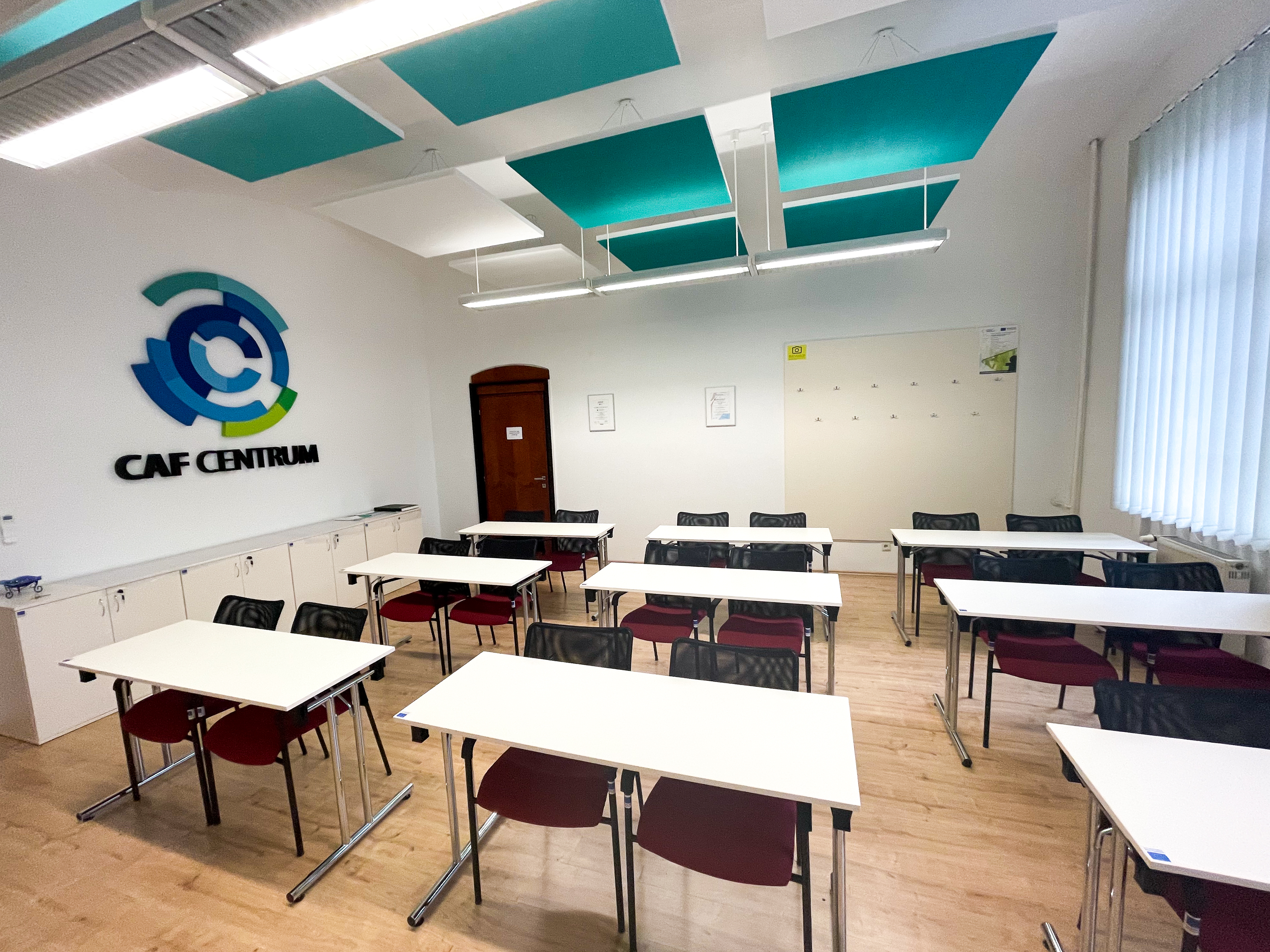
Acoustic treatment works with surfaces. Absorptive materials on walls and ceilings shorten reverberation, so reflections stop masking the direct sound. The room becomes more predictable and the technology can begin to perform as intended.
Technology works with direction and coverage. Correctly selected and aimed loudspeakers send sound towards the people who need to hear it and less towards reflective surfaces. Microphones also belong to this layer because their choice and placement determine how much of the room they capture.
Acoustic treatment reduces the amount of reflected sound, while technology improves the ratio between the direct sound and the reflections that remain. Where speech is unintelligible, both layers usually need attention, although not necessarily to the same extent.
We explain how the same principle affects the choice between different system types in our article about when to choose a line array for corporate spaces.
How to determine in advance which approach will help
For smaller spaces such as meeting rooms, this is determined using a model rather than measurement. The technician creates an acoustic model from the room dimensions, wall surfaces and selected acoustic material, and the model generates a graph showing conditions before and after treatment. You can therefore see in advance what acoustic treatment will change in that specific room, before anything is ordered. We explain what the model contains and when it replaces a full study in our article about when you need an acoustic study.
Reverberation time is not normally measured in meeting rooms because the behaviour of such a space can be estimated from its dimensions and surfaces. At this scale, the model provides enough information to make the decision.
Two characteristics move the decision into a different category. According to MediaTech technicians, room acoustics should be simulated where there is tiered seating or where hard reflective surfaces dominate, such as extensive glazing or concrete. These are precisely the spaces where it would not be responsible to answer the question “treatment or technology?” without simulation.
For large-volume spaces such as theatres, cinemas and stadiums, room acoustics are addressed through a separate acoustic study. This includes simulation using EASE as well as acoustic measurements of reverberation time and speech intelligibility. MediaTech’s studies are usually prepared by a specialised external partner.
Which target values are used to assess the result
For meeting rooms and conference rooms, MediaTech targets a reverberation time of 0.6 to 1.0 seconds. For meeting rooms and video conferencing spaces, speech intelligibility should be at least STI 0.7. For congress halls, the target is 0.8 to 1.2 seconds and at least STI 0.6. For restaurants, lobbies and hotel spaces, the target reverberation time is 0.8 to 1.0 seconds. These are values that can realistically be achieved in a completed space, rather than figures from specialist literature based on ideal conditions.
MediaTech keeps the difference between the loudest and quietest listening positions within six decibels and checks this particularly in spaces with tiered seating. If the difference is greater, the problem lies in coverage, so acoustic treatment will not solve it. The full range of decisions that should be made before purchasing equipment is covered in our complete guide to sound systems for commercial spaces.
When technology, rather than acoustic treatment, is the right answer
Not every room requires changes to its surfaces, and in some cases such changes would achieve nothing.
If the room is acoustically well behaved but people still cannot understand the speech, the problem should be sought in the technology layer. It may be insufficient coverage, with dead zones where part of the audience is sitting. It may be an incorrectly selected or positioned microphone. Or it may be system configuration that nobody properly reviewed after installation.
There are also spaces where the surfaces cannot be altered at all. In historic and protected interiors, the solution must avoid disrupting the room, so the emphasis shifts towards technology and its placement. We explain how this is handled in practice in our article about sound systems for historic and design-sensitive spaces.
In these cases, buying acoustic panels would be an expense with no effect. This is why it is still worth starting with a model and a discussion of what is actually wrong in the room before placing an order.
What this means for the sequence of work and the budget
The sequence of decisions affects the result more than the specific choice of material. Acoustic treatment is easiest to implement while surfaces, suspended ceilings and materials can still be changed, meaning during construction or refurbishment.
Once the interior is complete, the same treatment requires a second intervention in the finished space and some solutions may no longer be available. At that point, a greater share of the problem has to be solved through technology.
This leads to a practical budgeting rule. If you are building or refurbishing, have the acoustics assessed before the suspended ceilings are closed. If you are taking over an existing finished space, expect the balance between acoustic treatment and technology to be different from a new-build project. We explain where acoustics belongs in the construction timeline in our article about AV coordination within a construction project.
What to ask the supplier
Three questions separate a supplier who has assessed the space from one who is simply proposing the products they sell.
- Does the cause lie in the room or in the technology, and what evidence supports that conclusion? The answer should refer to dimensions, surfaces and a model rather than an impression from a photograph.
- What changes if we do not carry out the acoustic treatment? A supplier working with a model can show a comparison of conditions before and after treatment.
- How much of the improvement do you attribute to the treatment and how much to the technology? This forces the supplier to define the balance between the two, which can later be verified.
A supplier who answers all three questions by proposing a more powerful amplifier is treating the symptom because they have not established the cause. We cover the remaining criteria for evaluating a supplier in our article about how to choose a sound system supplier.
Frequently asked questions
What should we do if acoustic treatment was not enough? If the treatment has already been installed and speech is still difficult to understand, the remaining problem lies in the technology. Check the coverage for dead zones where people are sitting, the choice and placement of microphones, and the system configuration that may not have been properly reviewed after installation. These are three things acoustic treatment cannot solve.
Can acoustics be addressed in a space that cannot be physically altered? Yes, but the emphasis shifts towards technology and its placement. In historic and protected interiors, the objective is to find a solution that does not disrupt the space. Buying acoustic panels may have no effect if they cannot be installed where they would actually help.
When is it easiest to address acoustics? While surfaces, suspended ceilings and materials can still be changed, meaning during construction or refurbishment. Once the interior is complete, the same treatment requires another intervention in the finished space and some solutions may no longer be available. This increases the proportion of the problem that must be solved through technology.
Is proposing both acoustic treatment and a replacement amplifier unnecessary upselling? Where speech is unintelligible, both layers often need to be addressed, so proposing both can be justified. The difference between a well-founded proposal and unnecessary upselling is whether the supplier can explain the balance between the two and support it with a model. If they cannot define that balance, ask for the model.
What does it mean if the sound is poor only in some parts of the auditorium? If it is fine elsewhere, this points more towards a coverage problem than room acoustics because acoustic problems tend to affect the space more broadly. With tiered seating and a predominance of hard reflective surfaces, however, the two can overlap, in which case room acoustics should be simulated. MediaTech keeps the difference between the loudest and quietest listening positions within six decibels, so this can also be measured.
Do I need an acoustic study to make the decision? Not for a meeting room or ordinary commercial space. An acoustic model is sufficient. A full acoustic study with EASE simulation and measurements of reverberation time and speech intelligibility is intended for large spaces such as theatres, cinemas and stadiums. It is a separately paid service that MediaTech usually has prepared by a specialised external partner.
Next step
If speech is difficult to understand in your space and you are considering replacing the technology, first determine where the cause lies. Send us the floor plan and photographs of the room together with a description of what is not working, and we will explain what can be determined from the available information and what would need to be verified using a model.
Email us at mediatech@mediatech.sk or call +421 2 20 999 700.